Let's compare
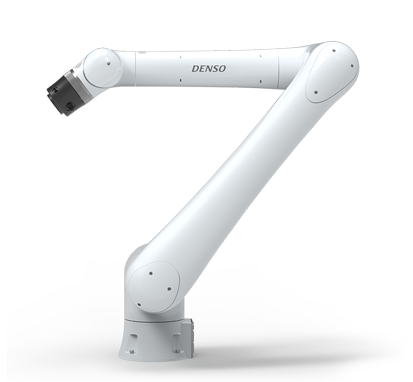
COBOTTA
DENSO Robotics
Not yet assessed
- Height
- —
- Payload
- —
- Verified autonomy
- not assessed
- Real deployment
- not assessed
- Status
- —
- Price
- —
COBOTTA
DENSO RoboticsCOBOTTA is a family of 6-DOF collaborative robot arms from DENSO Robotics, encompassing the original compact COBOTTA (~4 kg, small-scale) and the more capable COBOTTA PRO/HSR Series (900 mm and 1300 mm reach variants, 6–12 kg payload, up to 2,500 mm/s TCP speed). The PRO series features dual-mode operation—full speed when no humans are nearby, automatically slowing or stopping on human approach—with PL d / Cat. 3 functional safety certification and a CRC9 controller powered by Beckhoff TwinCAT. The robots are commercially available (price on request, estimated USD 25,000–40,000), support ROS/MoveIt, offline programming via WINCAPS/Wincaps3, AI imitative learning, and Blockly drag-and-drop programming, and have been deployed in pharmaceutical cleanrooms, laboratory automation, machine tending, and bin picking. As industrial cobots, they autonomously execute programmed tasks without a human performing or driving the task itself, though they require initial setup, programming, and periodic maintenance.
Availability
Specification
- degrees of freedom
- 6-DOF
- payload (COBOTTA PRO 900)
- 6 kg (spec sheet) / 9 kg (one community source)
- payload (COBOTTA PRO 1300)
- 12 kg
- reach
- 900 mm (PRO 900) / 1300 mm (PRO 1300)
- TCP speed (non-collaborative mode)
- Up to 2,500 mm/s (PRO 1300); 2,100 mm/s (PRO 900)
- weight
- Original COBOTTA: ~4 kg; COBOTTA PRO: 28.5–41 kg (spec sheet) / 32 kg (one community source)
Price
No public price — contact the supplier for a quote.
Good · Bad · Ugly
Evidence-graded claims from the DENSO Robotics deep report
DENSO robots operate autonomously during manufacturing tasks — humans are only involved in programming, setup, and maintenance, not in performing the tasks during operation
Community practitioner posts on r/PLC [17][18][19] independently confirm that DENSO robots execute programmed industrial tasks (assembly, pick-and-place) without real-time human intervention, consistent with standard industrial automation practice.
from DENSO Robotics deep report →Total cost of ownership may exceed initial quote due to add-ons, licensing, and activation fees
DENSO's own official buying guide [6] explicitly warns prospective buyers of these additional costs, making this a vendor-acknowledged limitation rather than a marketing claim; a third-party commerce source [7] independently corroborates software licensing costs of $5,000–$20,000.
from DENSO Robotics deep report →DENSO has donated $800,000+ to FIRST Robotics since 2002 and granted $155,000 to Kettering University for industrial robotics education
The FIRST Robotics donation figure is reported in a DENSO press release [10], and the Kettering University grant is independently confirmed by Kettering University's own news release [14], providing a non-vendor corroboration for the latter figure.
from DENSO Robotics deep report →
DENSO is the world's largest manufacturer and user of small assembly robots
This claim appears consistently across DENSO's own official sources [1][2][4] but no independent third-party audit, industry analyst report, or regulator has verified the market-share ranking in the supplied dossier.
from DENSO Robotics deep report →143,000+ robots deployed at external customer sites (most recent figure)
The 143,000+ figure comes exclusively from DENSO's own homepage [1]; older official pages cite only 80,000+, and no independent source verifies any specific deployment count.
from DENSO Robotics deep report →27,000+ robots deployed in DENSO's own manufacturing facilities
The 27,000+ in-house figure is sourced solely from DENSO's homepage [1], with older official pages citing only 20,000+; no independent facility audit or third-party verification exists in the dossier.
from DENSO Robotics deep report →DENSO robots use harmonic-drive motors enabling high-speed continuous multi-shift operation with a ~35,000-hour greasing interval
The harmonic-drive claim is from DENSO's official source [4], and a single community post [18] corroborates a 35,000-hour greasing interval, but this is one unverified user report and no independent durability test or third-party benchmark is present in the dossier.
from DENSO Robotics deep report →
About the company
Editorial directory of real robot products from leading global manufacturers. Each entry links to the manufacturer's official page.