RealSense Depth Camera D455
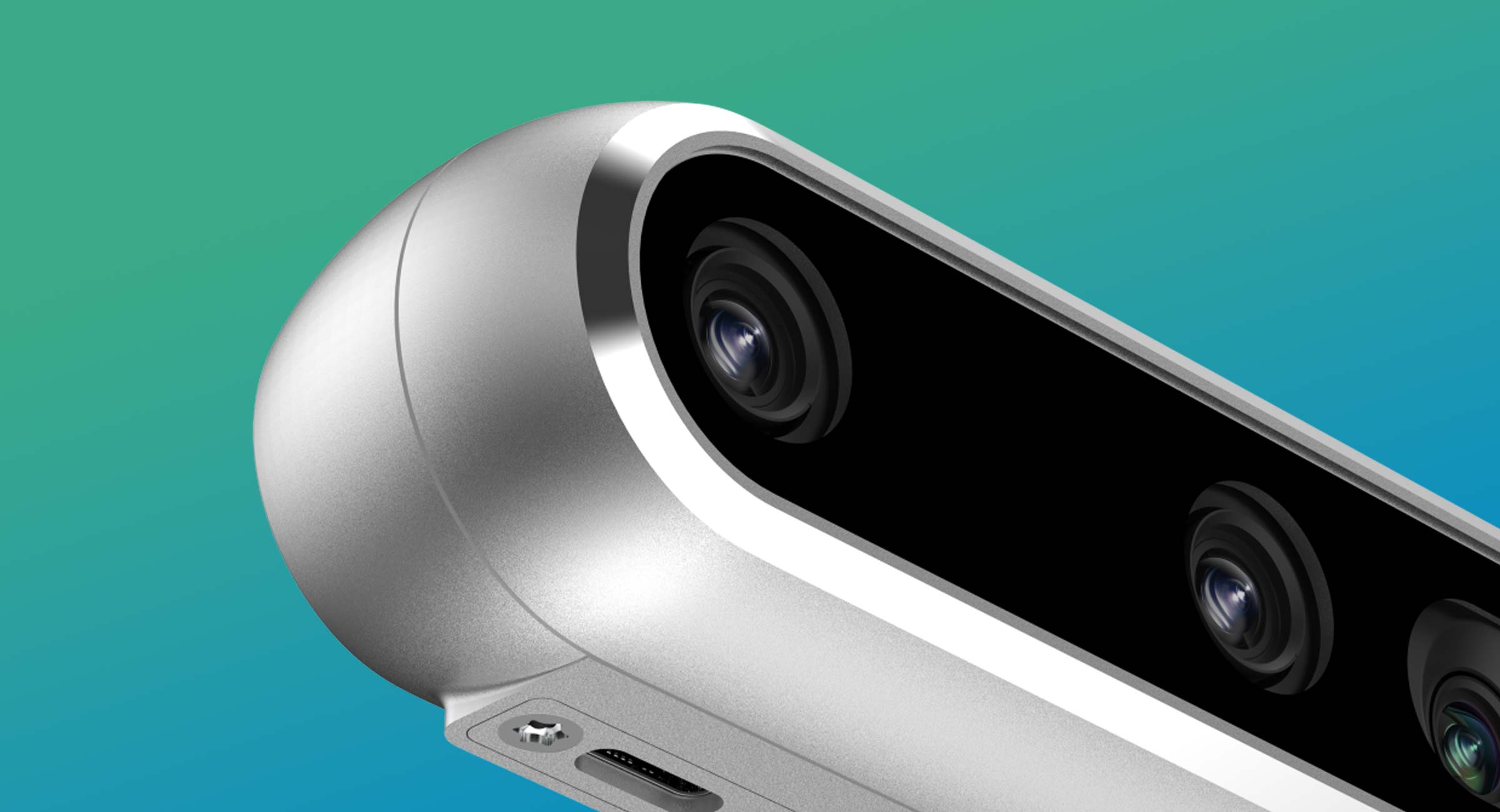
The RealSense Depth Camera D455 is a stereoscopic active-infrared depth camera belonging to Intel's D400 series, designed to capture high-fidelity depth data for robotics, autonomous mobile robots (AMRs), drones, and computer-vision applications. It features a 95 mm stereo baseline — the widest in the D400 lineup at the time of its introduction — which reportedly enables depth error of under 2% at ranges up to approximately 4 metres. Originally developed under the Intel RealSense brand, the D455 and related products were later spun off as part of an independent RealSense business unit following Intel's restructuring of the division around 2021–2022. The camera is widely adopted in research, industrial automation, and humanoid-robot development owing to its compact USB-powered form factor, open SDK support, and relatively accessible price point.
Overview and Use Cases
The RealSense Depth Camera D455 is a self-contained depth-sensing module that combines stereo infrared imaging with an active IR projector to produce dense, metric depth maps in real time. It is part of the broader D400 series, which targets applications requiring reliable short-to-medium range depth perception in varied lighting conditions.
Common deployment scenarios include:
- Autonomous Mobile Robots (AMRs): obstacle detection, navigation, and 3-D mapping
- Humanoid and service robots: body-pose estimation, workspace awareness, and manipulation guidance
- Drones and UAVs: terrain-following and collision avoidance
- Industrial inspection: dimensional measurement and surface scanning
- Research and prototyping: rapid integration via ROS/ROS 2 wrappers and an open SDK
Key Technical Details
The D455 distinguishes itself within the D400 family primarily through its extended baseline and improved range accuracy:
- Stereo baseline: 95 mm (wider than the D435/D435i, which uses approximately 50 mm)
- Depth technology: Active stereo with an IR dot projector
- Reported depth error: Under 2% at ranges up to ~4 m under typical conditions
- RGB sensor: Integrated global-shutter color camera
- IMU: Built-in inertial measurement unit (accelerometer + gyroscope), useful for motion compensation and SLAM
- Interface: USB 3.1 Gen 1 (USB-C connector), bus-powered
- Operating range: Reportedly effective from approximately 0.6 m to 6 m, depending on scene texture and lighting
- Form factor: Compact bar-style housing suited for mounting on robot heads, arms, or chassis
All figures above are drawn from publicly available RealSense documentation; users should consult the current datasheet for the most up-to-date specifications.
Comparison to Related Products
Within the D400 series:
- The D435i is a popular predecessor with a ~50 mm baseline and similar USB form factor, but shorter effective range and higher depth error at distance.
- The D415 uses a narrower baseline optimised for close-range, high-resolution scanning rather than long-range accuracy.
- The D455's wider baseline and global-shutter RGB sensor make it the preferred choice when accuracy beyond 2–3 m is required.
Versus competitors:
- Microsoft Azure Kinect DK offers a higher-resolution depth sensor (ToF-based) and wider field of view but is larger, more power-hungry, and was discontinued as of 2023.
- Stereolabs ZED 2 / ZED X cameras offer longer range and neural-depth processing but at a significantly higher price point and requiring an NVIDIA GPU for full functionality.
- Orbbec Gemini series provides comparable active-stereo depth at competitive pricing, increasingly adopted in cost-sensitive AMR designs.
The D455 occupies a mid-range position: more capable than entry-level structured-light sensors, yet more accessible than premium ToF or neural-stereo solutions.
Market Context and Target Buyers
The D455 is positioned as a professional-grade, developer-friendly depth camera at a price point generally accessible to university research labs, startup robotics teams, and mid-tier industrial integrators. It does not require a dedicated compute card, making it easy to pair with controllers such as the NVIDIA Jetson Orin NX for edge-AI pipelines.
Target buyers include:
- Robotics researchers and academics
- AMR and logistics-robot OEMs
- Humanoid-robot developers integrating perception stacks
- Machine-vision system integrators
Notable Deployments and Ecosystem
As of public reporting, the D455 and its D400-series siblings have been integrated into a wide range of commercial and research platforms, including various AMR chassis, research humanoids, and drone payloads. The camera's compatibility with ROS/ROS 2 via the realsense-ros package and Intel's open-source librealsense SDK has made it a de-facto standard sensor in many academic robotics curricula.
Several humanoid-robot projects and open-source manipulation platforms have publicly documented use of D400-series cameras for head-mounted perception, though specific customer names are not always disclosed.
Future Outlook
Following Intel's restructuring of the RealSense division, the long-term product roadmap has been subject to uncertainty. As of public reporting through early 2024, the D455 remains available through distribution channels, but prospective buyers are advised to monitor the RealSense brand's ownership and support status. Growing competition from Chinese depth-camera manufacturers and the maturation of LiDAR costs may pressure the D455's market position in AMR applications, while its strong software ecosystem and established developer community continue to sustain demand in research and prototyping contexts.
Community buzz (Reddit)
Pepsi, where’s my jet?
r/BeAmazed · ▲ 66,172
"He could literally r*pe a child on Fox News, look to the camera and say "Are you enjoying this America?" and his cult would still find an excuse for him." Trumpers in r/TikTokCringe get triggered over a clip of Trump alluding to hiring young women too entrap them
r/SubredditDrama · ▲ 38,145
My wife dropped her sunglasses into a deep lake, so I built a small underwater ROV with a gripper to try to retrieve them
r/DIY · ▲ 20,354
Went to see Ed Sheeran - saw a SteamDeck controlled camera robot too
r/SteamDeck · ▲ 19,246
Mars rock gets stuck on Curiosity rover's drill - Takes 5 days to shake off
r/spaceporn · ▲ 18,566
Related entries
 Robot
RobotRelay Delivery Robot
The Relay Delivery Robot is an autonomous indoor delivery robot developed by Relay Robotics (formerly known as Savioke), designed primarily for hospitality and healthcare environments. It navigates hotel corridors and hospital hallways independently, rides elevators without human assistance, and delivers guest amenities, medications, linens, and other supplies directly to rooms or designated drop-off points. Relay is one of the most widely deployed service robots in its category, reportedly completing over one million lifetime deliveries with a publicly cited success rate of approximately 99.8%. With a cargo capacity of around 10 gallons, the robot is compact enough to operate in busy public spaces while carrying a meaningful payload of everyday supplies.
2,683 views
 Robot
RobotSpot
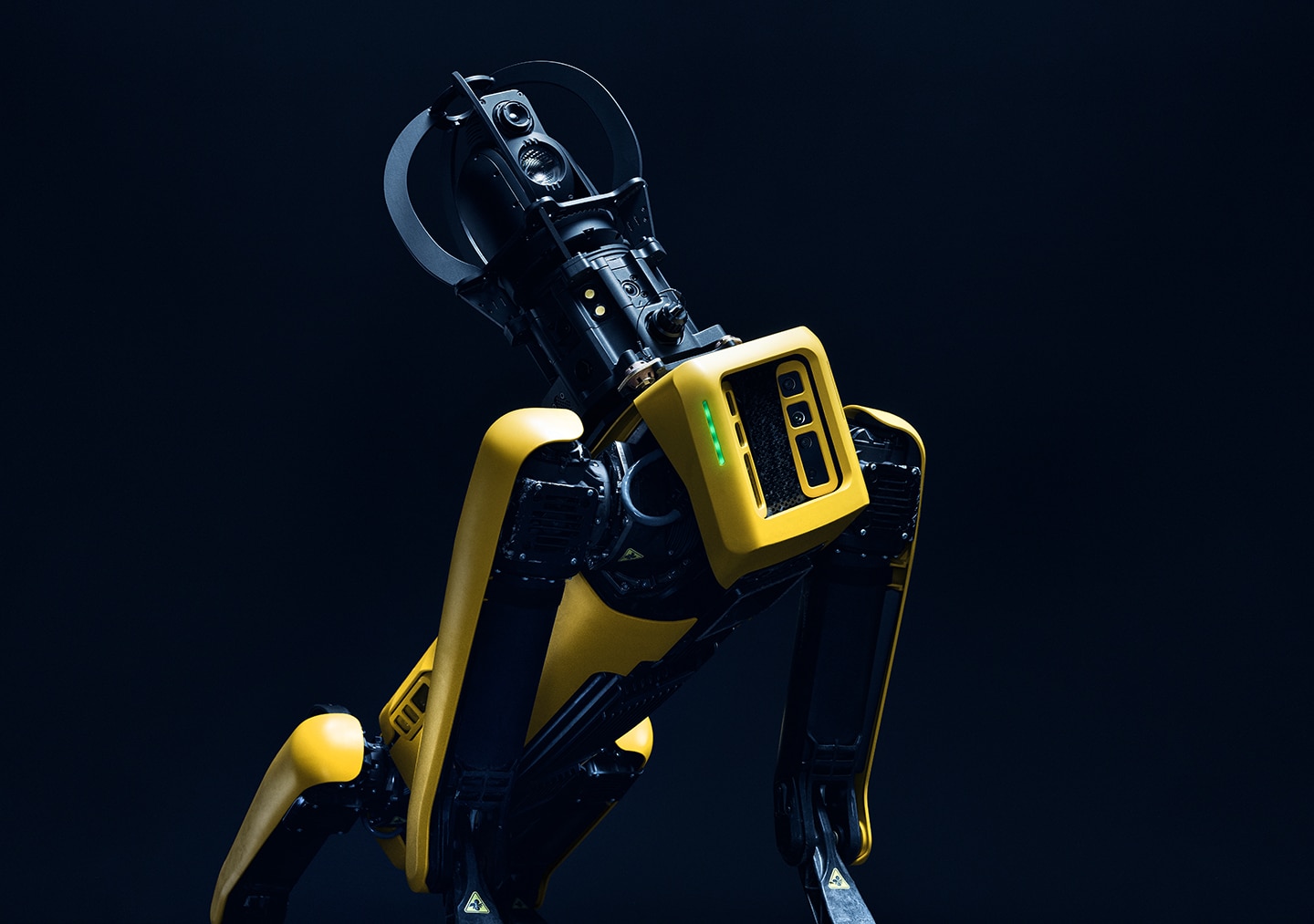
Spot is a four-legged autonomous robot developed by Boston Dynamics, a robotics company headquartered in Waltham, Massachusetts. Designed for inspection, security, and data collection in complex or hazardous environments, Spot can navigate stairs, rough terrain, and confined spaces that are inaccessible to wheeled robots. It is commercially available and has been deployed across industries including utilities, oil and gas, construction, and public safety. Spot supports a modular payload system that accommodates thermal cameras, pan-tilt-zoom (PTZ) cameras, lidar units, methane sensors, and other mission-specific hardware. Boston Dynamics also offers the Orbit fleet-management software platform, enabling operators to schedule autonomous inspection routes, aggregate sensor data, and manage multiple Spot units from a central interface. The robot is widely regarded as one of the most capable and commercially mature legged robots on the market.
1,164 views
Rosie 2.0
The Rosie 2.0 is a commercial-grade autonomous robot vacuum developed by Tailos, designed to handle large-scale floor cleaning in business and institutional environments. It is offered in a two-pack configuration, allowing facilities to deploy multiple units simultaneously for broader coverage and more efficient cleaning cycles. Built to commercial durability standards, the Rosie 2.0 combines intelligent navigation with powerful suction technology to reduce reliance on manual labor and improve facility maintenance consistency. It targets businesses, hospitality venues, retail spaces, and other high-traffic environments where reliable, automated cleaning is a priority.
478 views
 Robot
RobotLOVOT
LOVOT is a home companion robot developed by Japanese startup GROOVE X, designed not to perform household tasks but to foster genuine emotional bonds with its owners. It responds to human presence, touch, and mood through a suite of sensors and expressive behaviors, including large animated eyes, warm body temperature, and soft tactile surfaces. First unveiled in 2018 and made available to consumers in Japan, LOVOT represents a distinct philosophy in robotics: that a robot's value can lie entirely in emotional support and companionship rather than utility. It is the sole product line from GROOVE X and has attracted attention from researchers, media, and consumers interested in the intersection of robotics and emotional well-being.
346 views