Let's compare
Skydio R10
Skydio
Not yet assessed
- Height
- —
- Payload
- —
- Verified autonomy
- not assessed
- Real deployment
- not assessed
- Status
- —
- Price
- —
Skydio R10
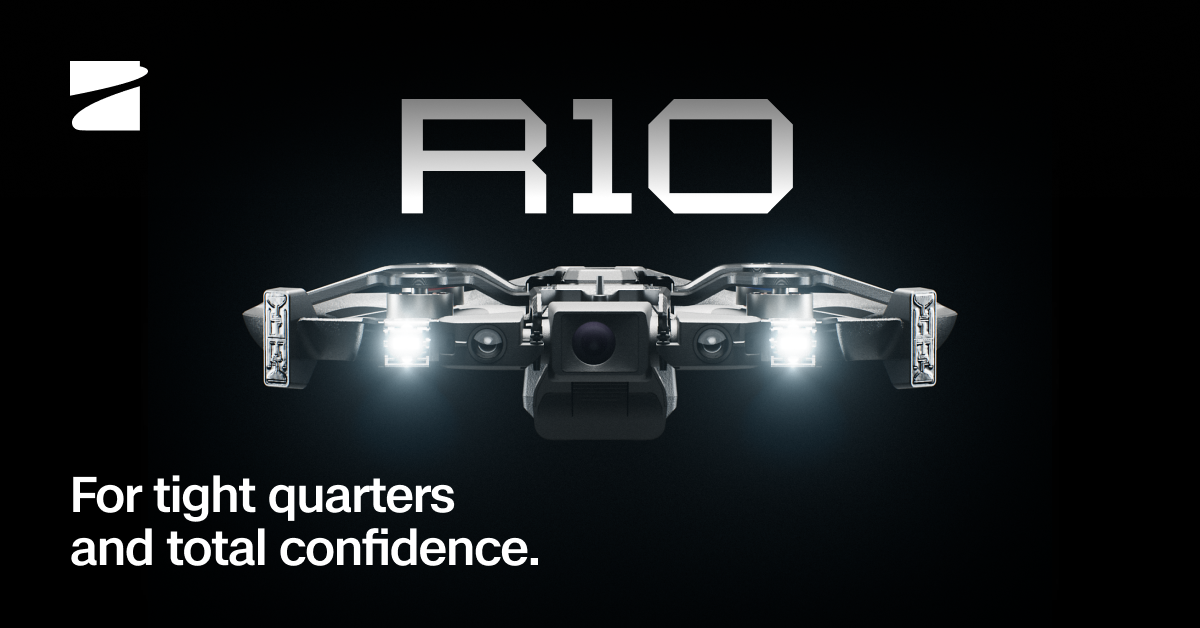
SkydioSkydio R10 is a compact indoor drone for tight quarters featuring AI-driven obstacle avoidance, NightSense low-light capability, 4K low-light camera, dual LED floodlights, two-way communications, and 3-hour perch streaming. Built with composite frame and propeller guards for durability in cluttered spaces.
Availability
Specification
- Compact composite frame, 1.73 lb (785 g) with reinforced propeller guards
- 180° pitch gimbal for overhead and beneath-obstacle inspection
- Dual forward-facing navigation cameras with NightSense for zero-light obstacle avoidance
- 4K camera with 1-inch sensor, 12.5MP photos, optimized for low-light performance
- High-power dual LED floodlights for dark/zero-light navigation
- Built-in 82 dB speaker and microphone for two-way communications
- Perch Mode enables up to 3 hours streaming while conserving battery
- Dual SIM cellular option with Connect Fusion for network redundancy
- Turtle Mode for automatic uprighting after upside-down landing
- AI-driven autonomy with automated path-remembering and backtracking
Price
No public price — contact the supplier for a quote.
Good · Bad · Ugly
Evidence-graded claims from the Skydio deep report
Skydio DFR drones launch in under 20 seconds, arrive at incidents in under 90 seconds, arrive first 71% of the time, and resolve ~25% of calls without a patrol unit
These specific performance metrics appear only in Skydio's own Series F announcement [14] and official DFR page [3]; no independent third-party test, regulator report, or customer audit corroborating these figures is present in the dossier.
from Skydio deep report →Skydio's DFR program reduced auto theft by 42% in San Francisco
This statistic is sourced exclusively from Skydio's Series F announcement [14] with no independent police department report, city government data, or third-party analysis found in the dossier to verify the causal attribution.
from Skydio deep report →Skydio has shipped 60,000 autonomous drones, accumulated 4.5M+ customer flights, and serves 3,800+ enterprise customers including all U.S. DoD branches and 29 allied nations
All deployment figures originate from Skydio's own Series F announcement and homepage [14][1]; the $50M U.S. Army contract for 3,000 drones [14] lends partial credibility to military claims, but no independent audit, government procurement record, or third-party verification of the aggregate figures is present in the dossier.
from Skydio deep report →Skydio's autonomous 3D scanning operates without prior maps, a magnetometer, or internet connectivity
This capability is documented in Skydio's official support documentation [9] and corroborated by an independent Scanifly hardware review [7] for the Skydio 2, but the Scanifly review focuses on hardware specs rather than independently testing the no-map/no-internet scanning claim end-to-end.
from Skydio deep report →