Let's compare
Saildrone Explorer
Saildrone Ocean Systems
Not yet assessed
- Height
- —
- Payload
- —
- Verified autonomy
- not assessed
- Real deployment
- not assessed
- Status
- —
- Price
- —
Saildrone Explorer
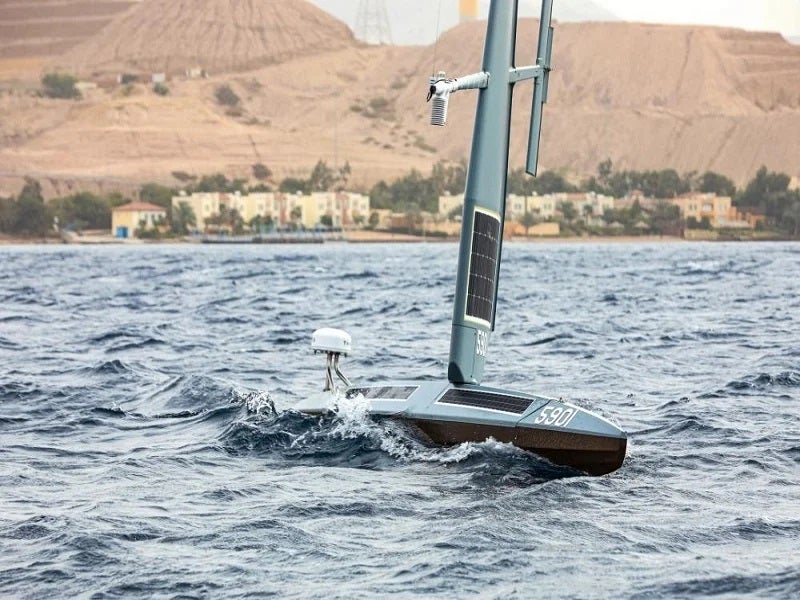
Saildrone Ocean SystemsThe Saildrone Explorer is a 23-foot (7-metre), wind- and solar-powered unmanned surface vehicle (USV) developed by Saildrone Inc. since 2013, offering over 12 months of endurance at ~3 knots average speed. It operates via remote waypoint tasking — operators send coordinates and the vessel autonomously adjusts its rudder and sail to follow them — while human operators (Saildrone staff) navigate and manage the USVs and mission clients (e.g., NOAA) define operational objectives. The platform carries a broad sensor suite including metocean instruments, hydroacoustics, 360-degree cameras with ML-based anomaly detection, and optional bathymetry sonars, streaming data in real time via Iridium satellite. With over 1 million miles and 32,000 days at sea across deployments including Arctic surveys, Atlantic hurricane intercepts, fisheries assessments, and maritime domain awareness trials, it is a mature, extensively deployed platform operating under supervised-autonomous conditions.
Availability
Specification
- hardware_dimensions
- 23 feet (approximately 7 metres) long; 15-foot rigid carbon fibre wing-sail; 6-foot deep skeg
- propulsion_and_power
- Wind propulsion via rigid wing-sail; solar-charged internal batteries for electronics and hotel loads
- average_speed
- ~3 knots average
Price
No public price — contact the supplier for a quote.
Good · Bad · Ugly
Evidence-graded claims from the Saildrone Ocean Systems deep report
Saildrone secured a contract with the Danish Armed Forces deploying 4 Voyager USVs in the Baltic Sea (June 2025), marking expansion into European defense markets.
Defense Daily [9] independently reports the Danish fund-led investment and USV deployment to northern/Baltic waters, corroborating the defense expansion claim; however, specific operational outcomes (mission performance, data quality) of the 4 Voyagers remain unverified.
from Saildrone Ocean Systems deep report →Saildrone operates on a Mission-as-a-Service (MaaS) model, selling data and mission services rather than vehicles, with a GSA schedule contract confirming U.S. government procurement eligibility.
The GSA Advantage contract document [1] independently confirms U.S. government procurement eligibility and specific service pricing (per dispatch/recovery events for 3 Explorers at ~$48,866–$49,370), directly substantiating the MaaS model and government customer base; the $500K maximum order per SIN is also documented.
from Saildrone Ocean Systems deep report →
Saildrone has accumulated over 2 million nautical miles and 60,000+ days at sea across its operational history.
The 2M+ nautical miles / 60,000+ days figures are cited across multiple vendor and commercial analysis sources (including the Lockheed Martin investment announcement context), but all originate from or closely echo Saildrone's own communications — no independent third-party verification (e.g., regulator, customer audit, or journalist investigation) of these cumulative statistics has been documented.
from Saildrone Ocean Systems deep report →Saildrone's USVs are wind and solar powered, requiring no fuel for propulsion.
Wind/solar propulsion is consistently stated across vendor and independent commercial analysis sources, and is not contradicted anywhere in the dossier, but no independent technical teardown, certification body, or customer operational report specifically confirms the zero-fuel propulsion claim.
from Saildrone Ocean Systems deep report →Saildrone USVs can carry up to 20 science sensors covering above- and below-water domains, including radar, cameras, and acoustic sensors.
The 20-sensor payload figure and sensor suite description are consistently cited across vendor and news sources (including defense news confirming Voyager hardware), but no independent payload test report or customer data sheet independently verifies the specific 20-sensor capacity or the full sensor suite performance.
from Saildrone Ocean Systems deep report →Lockheed Martin is integrating Saildrone USVs with electronic warfare (EW), anti-submarine warfare (ASW), surveillance, and kinetic effects capabilities, with live-fire demos planned for 2026.
Both Lockheed Martin's own press release [4] and Saildrone's press release [10] confirm the strategic collaboration and planned 2026 live-fire demos, but these are dual vendor announcements — no independent defense reporter, government procurement record, or Navy confirmation independently verifies that EW/ASW/kinetic integration has been demonstrated or contracted beyond the announcement.
from Saildrone Ocean Systems deep report →Saildrone's operational cost is approximately $2,500/day — roughly 1/10th the daily cost of conventional research or survey vessels.
The ~$2,500/day figure and the 1/10th cost comparison are cited in commercial analysis sources [3][5], and the GSA contract [1] provides specific per-dispatch pricing consistent with low operational overhead, but the comparison baseline ($80M–$150M ships at up to $100K/day) originates from vendor or vendor-adjacent sources rather than an independent fleet cost study.
from Saildrone Ocean Systems deep report →
About the company
Editorial directory of real robot products from leading global manufacturers. Each entry links to the manufacturer's official page.