Let's compare
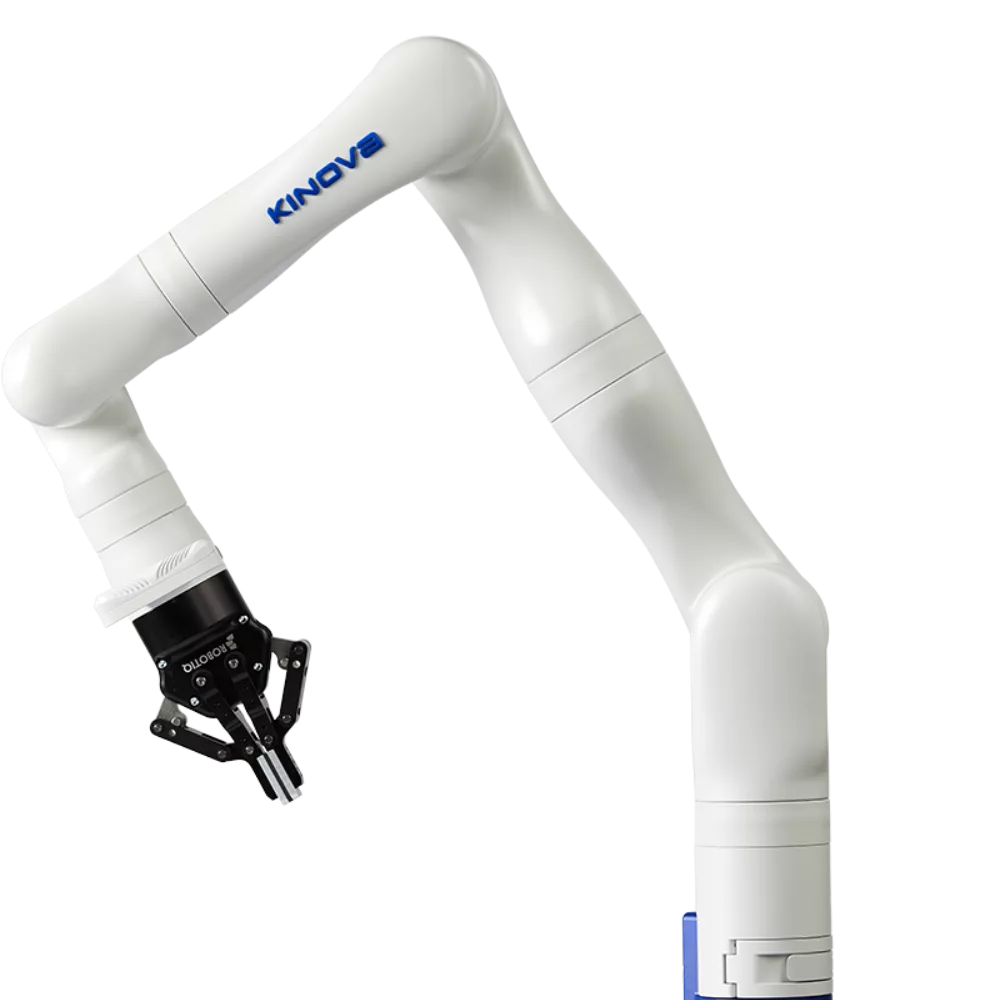
KINOVA Gen3 6 DoF
Kinova Gen3
Not yet assessed
- Height
- —
- Payload
- —
- Verified autonomy
- not assessed
- Real deployment
- not assessed
- Status
- —
- Price
- —
KINOVA Gen3 6 DoF
Kinova Gen3The Kinova Gen3 6 DoF is a lightweight robotic manipulator arm manufactured by Kinova Robotics (founded 2006, Boisbriand, Quebec, Canada). The 6 DoF variant offers a 4 kg payload, 891 mm reach, integrated torque sensors in smart actuators, infinite joint rotation, and an optional 2D/3D vision module, programmable via the Kortex API (C++, Python, MATLAB, ROS). It is a research/industrial platform deployed across academia, assistive technology, medical OEM, defense, and industrial automation contexts — it does not autonomously perform tasks on its own but rather serves as a programmable manipulator whose autonomy level depends entirely on the application software built on top of it. Community reports confirm real software issues including URDF/hardware joint limit mismatches, inaccurate multi-joint speed control, gravity droop during servo use, and simulation instability.
Availability
Specification
- degrees of freedom (system under review)
- 6 DoF (this system); 7 DoF variant also exists
- payload
- 4 kg
- reach
- 891 mm (6 DoF variant)
Price
No public price — contact the supplier for a quote.
Good · Bad · Ugly
Evidence-graded claims from the Kinova Gen3 deep report
The Kinova Gen3 has no autonomous task-execution capability — all task performance requires human programming and direction.
The Formant/Kinova partnership announcement [10] explicitly frames the Gen3 as a teleoperation platform, and the dossier's autonomy verdict (confidence 0.88) confirms no onboard autonomous task planning exists; however, this verdict is primarily derived from vendor-adjacent documentation rather than an independent third-party benchmark.
from Kinova Gen3 deep report →ROS integration with the Gen3 presents practical challenges including dependency complexity and library version deprecation.
An independent community discussion on r/robotics [11] corroborates ROS dependency and deprecation issues as real practitioner pain points, though the thread is not Gen3-specific and reflects broader ROS ecosystem frustrations rather than a controlled Gen3 evaluation.
from Kinova Gen3 deep report →
The Gen3 has been adopted by hundreds of universities, startups, and corporations.
This figure appears only in a commerce/aggregator source [4] (Qviro), not in any independent audit, academic survey, or third-party report, making it unverified despite being plausible given Kinova's market position.
from Kinova Gen3 deep report →The Gen3 supports 1 kHz closed-loop control with integrated per-actuator torque, position, current, voltage, temperature, and IMU sensors.
The official spec sheet [8] and multiple commerce sources [2][3] consistently cite these figures, but all sources trace back to Kinova's own documentation chain; no independent third-party benchmark or teardown has verified the 1 kHz control loop performance in practice.
from Kinova Gen3 deep report →The Gen3 is suitable for medical and assistive device applications.
Commerce and news sources [4][6][7] list medical and assistive devices as target markets, and Kinova's funding announcements [6][7] reference these sectors, but no independent clinical deployment, regulatory clearance beyond CE [2], or peer-reviewed medical use case is documented in the dossier.
from Kinova Gen3 deep report →Kinova has raised approximately $57M USD in total funding, including a ~$32M USD round led by Graham Partners with EDC participation.
News sources [6][7] and Tracxn [9] report the $48M round and investor names, but total cumulative figures vary across sources and no audited financial disclosure is available; the Foxconn investor listing and exact totals remain unverified by independent financial reporting.
from Kinova Gen3 deep report →
The Gen3's continuous full-range payload is 2.0 kg, not the 4 kg cited by some vendor/commerce listings.
The official Kinova spec sheet [8] (hosted by UK distributor Hot Robotics) states 2.0 kg continuous full-range payload, directly contradicting the 4 kg figure in commerce listings [3][4][5], which likely reflects a near-base or peak condition — a material over-claim for typical use.
from Kinova Gen3 deep report →The RoboDK database entry for the Kinova Gen3 lists 14 kg payload, 735 mm reach, and 30 kg weight.
The RoboDK figures [5] are dramatically inconsistent with all other sources including the official spec sheet [8] (2.0 kg payload, 902 mm reach, 7.2–8.2 kg weight), strongly indicating a data entry error or misattribution to a different robot entirely.
from Kinova Gen3 deep report →
About the company
Editorial directory of real robot products from leading global manufacturers. Each entry links to the manufacturer's official page.