Xaxxon Technologies
Founded 2008 · Canada · xaxxon.com
SnapshotCompany claim
Xaxxon develops and manufactures open source, low cost robotic remote-presence devices. Focused on internet-enabled autonomous systems using x86/64 and ARM architectures. Founded in 2008 as a division of PDM Inc.
- Founded
- 2008
- HQ
- Canada
- Models
- 1
- Categories
- 1
ContactCompany claim
- Address
- Not disclosed
Product families
Is this your company? Claim this profile to add verified data, respond to our analysis, and upgrade claims to Verified.
Claim this profile1. Executive Overview {#executive-overview}
Xaxxon Technologies is a Vancouver, Canada–based robotics manufacturer founded in 2008 as a division of PDM Inc. The company occupies a distinctive niche: open-source, low-cost robotic remote-presence and autonomous systems hardware, built on mainstream x86/64 and ARM architectures and aligned with the Open Source Robotics Foundation (OSRF). This positioning makes Xaxxon accessible to researchers, hobbyists, and small commercial operators who require capable hardware without the cost barriers of enterprise robotics platforms.
The company's publicly stated strengths are manufacturing experience, quality control discipline, and customer support — carried over from PDM Inc.'s broader operations. Its product line spans telepresence robots, autonomous navigation platforms, LIDAR sensors, and purpose-designed motor control PCBs. Third-party coverage from outlets including IEEE Spectrum, The Robot Report, and Geo Week News confirms that Xaxxon's products have drawn genuine external attention, particularly the OpenLIDAR sensor and the Oculus Prime platform.
Not yet disclosed: revenue scale, headcount, and total units shipped. Xaxxon is invited to claim or correct those figures for inclusion in this report.
Latest news
- KEENON Humanoid Pours Drinks at GCS 2026, 100,000 Others Run HotelsYanko Design·2026-06-15GENERAL
2. The Company Story {#the-company-story}
Xaxxon Technologies was established in 2008 as a division of PDM Inc., a Canadian firm with prior experience in manufacturing, quality control, and customer support. The founding narrative, as stated on the company's own site, frames Xaxxon explicitly as an outlet for "previously unrealized passions: software and robotic technologies" — suggesting the division was created deliberately to channel engineering ambition that PDM Inc.'s core business did not accommodate.
The company is headquartered in Vancouver, British Columbia, and operates at the intersection of open-source software culture and physical hardware manufacturing. Its stated focus on OSRF support and open-source design philosophy places it within the ROS (Robot Operating System) ecosystem, a community-driven standard that has become the de facto middleware layer for academic and research-grade robotics worldwide.
Publicly visible milestones include the development of the Oculus Prime telepresence and SLAM navigation platform, the Oculus Prime Pi Explorer variant, the OpenLIDAR sensor (noted by Geo Week News in November 2019 as "tiny, inexpensive and open source"), and the MALG motor controller PCB series, now in its third revision. Coverage in IEEE Spectrum in December 2015 places Xaxxon's video content alongside other notable robotics projects of that period, indicating the company had established a visible public profile by the mid-2010s. The Robot Report's categorization of Xaxxon under "Service Robots for Governmental and Corporate Use" suggests the platform has been positioned or evaluated for light professional deployment, not solely hobbyist use.
Not yet disclosed: a formal timeline of product launches, partnership announcements, or funding events. Xaxxon is invited to supply milestones for inclusion.
3. Product Portfolio {#product-portfolio}
Products & versions


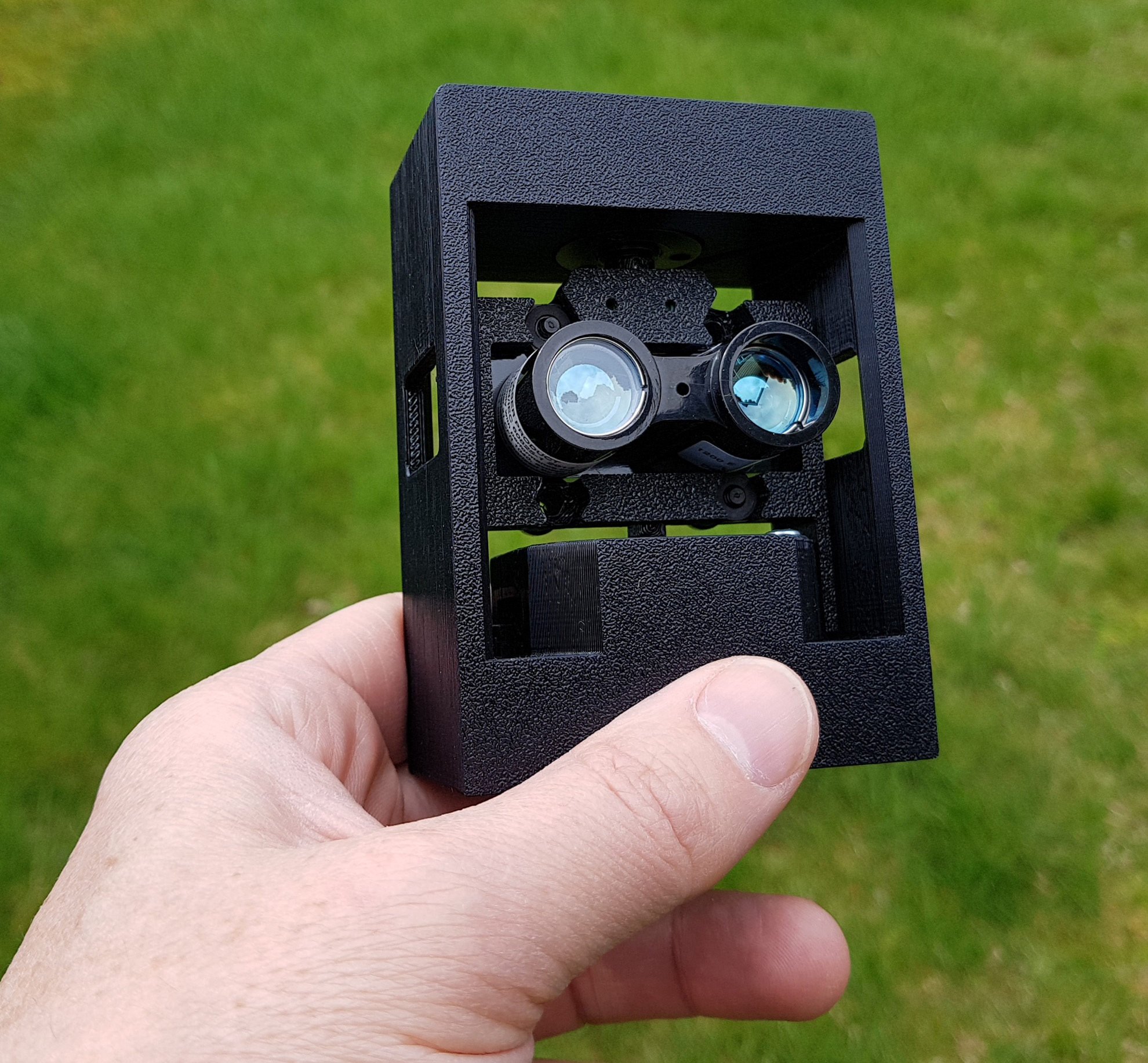
Xaxxon's public product lineup clusters into three broad families. The first is the Oculus Prime platform — a SLAM-capable autonomous navigator available in at least two configurations (the standard Oculus Prime SLAM Navigator and the Oculus Prime Pi Explorer), accompanied by an extra-parts offering that supports ongoing maintenance and customization. This platform is the company's most prominent product, combining autonomous navigation with remote-presence (telepresence) capability and documented LIDAR integration.
The second family is the OpenLIDAR sensor, offered as a standalone PCB-level product with its own documentation stream. Its open-source design and low price point attracted coverage from Geo Week News in 2019, which described it as notable for being simultaneously tiny, inexpensive, and fully open-source — a combination uncommon in the LIDAR market at the time.
The third family is the MALG PCB line, currently at version 3 (MALGv3), a motor controller board targeted at differential-drive robot builders. Priced at US $55.00 with gyroscope and US $47.00 without, it is a purpose-built microcontroller board centered on the Atmel ATMega 328P, with an L298 H-bridge, ST L3GD20 3-axis gyro, class-D audio amplifier, LED outputs, servo header, and USB-UART bridge — Arduino-compatible and compact at 99 mm × 51 mm. Supporting PCBs (POWERv2) appear in the navigation as additional line items. The lineup's overall shape is that of a vertically integrated open-source ecosystem: sensors, drive electronics, and complete robot platforms designed to interoperate and to be modified by the end user.
4. Technology Stack {#technology-stack}
Xaxxon's stated architectural focus on x86/64 and ARM processors positions its platforms to run full Linux environments and, by extension, ROS or ROS2 — the standard middleware for autonomous navigation in the open-source robotics community. This is a meaningful technical choice: it distinguishes Xaxxon's robots from microcontroller-only platforms and enables onboard SLAM, network connectivity, and software extensibility without requiring an external compute host.
At the component level, the MALGv3 board reveals concrete engineering decisions. The Atmel ATMega 328P running at 16 MHz serves as the real-time motor control layer — the same microcontroller used in mainstream Arduino Uno boards, ensuring broad software compatibility and a large developer community. The L298 dual H-bridge handles motor drive up to 1.4 A. The ST L3GD20 3-axis MEMS gyroscope (mounted on a removable daughter board, part number XAX-078) enables rotational odometry correction — a standard technique for improving dead-reckoning accuracy in differential-drive robots. The TPA2005 class-D amplifier (1.4 W into 8 Ω) provides audio output, relevant for telepresence use cases. The CP2104 USB-UART bridge with Micro-B USB input simplifies PC-side programming and debugging.
Our read: The combination of a high-level ARM/x86 compute board (implied by the Oculus Prime's SLAM capability) with a dedicated real-time ATMega 328P motor controller is a well-established two-tier architecture in open-source robotics. It separates latency-sensitive motor control from higher-level perception and planning, which is sound practice. The OpenLIDAR sensor, described in press coverage as tiny and low-cost, suggests Xaxxon is engineering for bill-of-materials discipline — prioritizing accessibility over premium specifications.
Not yet disclosed: specific SLAM algorithms, sensor fusion approaches, range/accuracy specifications for the OpenLIDAR, or compute board details for the Oculus Prime. Xaxxon is invited to claim or correct these details.
5. Research, Papers, Authors, Labs {#research-papers}
Company-linked papers
Xaxxon Technologies does not appear to be a research-publishing organization. This is consistent with its profile as a small commercial hardware manufacturer rather than an academic or R&D institution — the large majority of service-robotics hardware firms at this scale operate similarly. No peer-reviewed papers, technical reports, or named research authors have been identified in the available data. Xaxxon's intellectual contribution is expressed through open-source hardware and software releases rather than academic publication.
6. Media Evidence {#media-evidence}
Media library
Three independent third-party outlets have covered Xaxxon's work in the available data. Geo Week News (November 2019) covered the OpenLIDAR sensor directly, describing it as "tiny, inexpensive and open source" — a substantive editorial endorsement from a publication focused on geospatial and sensing technology. IEEE Spectrum (December 2015) included Xaxxon in its "Video Friday" roundup alongside other notable robotics projects, indicating the company had sufficient visibility to appear in the robotics industry's most widely read engineering magazine. The Robot Report has categorized Xaxxon under "Service Robots for Governmental and Corporate Use," suggesting editorial assessment of the platform's applicability beyond the hobbyist segment.
7. Commercial Reality {#commercial-reality}
Customers & deployments
Revenue, customer count, unit shipment volumes, and deployment ROI data are not disclosed in any available public source. Xaxxon maintains an active e-commerce storefront (denominated in US dollars, with in-stock status confirmed for the MALGv3 board), which confirms ongoing commercial activity, but no figures are available to characterize its scale.
The Robot Report's classification under governmental and corporate service robots is noted as an editorial signal, not a confirmed customer disclosure. Xaxxon is warmly invited to share customer case studies, deployment numbers, or revenue ranges for inclusion in this report — doing so would materially strengthen the commercial credibility signal for prospective buyers and partners.
8. Markets and Use Cases {#markets-use-cases}
Xaxxon's products address several overlapping market segments, derivable from the platform names and press categorizations in the available data.
Telepresence and Remote Presence: The Oculus Prime's naming and the company's self-description as a developer of "robotic remote-presence devices" places it squarely in the telepresence robot market — enabling a remote operator to navigate a physical space via an internet-connected robot. This has applications in corporate office environments, facility inspection, and remote work scenarios.
Autonomous Indoor Navigation: The "SLAM Navigator" designation on the Oculus Prime indicates capability for Simultaneous Localization and Mapping — the technical foundation for autonomous movement in unmapped or dynamic indoor environments. Use cases include facility patrol, inventory assistance, and research platform deployment.
Surveillance and Security: Xaxxon's own About page lists "Surveillance" as a core category alongside Robotics, Automation, and Telepresence. Combined with The Robot Report's governmental and corporate classification, this points to light-duty autonomous surveillance applications — perimeter monitoring, remote inspection — for institutional customers.
Developer and Research Platforms: The open-source architecture, OSRF alignment, Arduino-compatible motor controller, and OpenLIDAR sensor collectively serve the robotics research and developer community. Universities, independent researchers, and robotics educators represent a natural market for hardware that is documented, modifiable, and priced accessibly.
Geospatial and Sensing Applications: Geo Week News' coverage of the OpenLIDAR sensor suggests relevance to the geospatial data-capture community — indoor mapping, point-cloud generation, and environment modeling for architecture, construction, or facilities management.
9. Competitive Landscape {#competitive-landscape}
Competitive comparison
| Robot | Maker | Autonomy | Conf. |
|---|---|---|---|
| iRobot Roomba Combo 10 Max | iRobot | Autonomous | 0.90 |
| Mobile ALOHA (Stanford) | Stanford University | Teleoperated | 0.90 |
| 1X NEO | 1X Technologies | Remote-Assisted | 0.90 |
Xaxxon operates in a competitive space that includes both commercial telepresence robot vendors and open-source robotics hardware suppliers. The distinguishing axes in this market are price point, openness of hardware and software, compute architecture, and SLAM capability. Xaxxon's explicit commitment to open-source design and OSRF support, combined with its Canadian manufacturing base, represents a meaningful differentiation strategy — particularly for buyers who require auditability, customization, or integration with existing ROS-based software stacks.
The open-source and low-cost positioning does carry tradeoffs relative to closed commercial platforms, which typically offer more polished out-of-box experiences and vendor support structures. Our read: Xaxxon's competitive thesis is that flexibility and cost accessibility outweigh those tradeoffs for its target buyers — a defensible position in research, education, and budget-constrained institutional markets.
10. Country Advantage / Geopolitical {#geopolitical}
Section not material for this company.
11. Hype vs Real vs Ugly {#hype-real-ugly}
Claim tracker
What is verified by independent sources:
- The OpenLIDAR sensor is real, shipped, and independently described by Geo Week News (2019) as "tiny, inexpensive and open source."
- Xaxxon's products appeared in IEEE Spectrum's Video Friday (2015), confirming public visibility at that time.
- The Robot Report has categorized Xaxxon under service robots for governmental and corporate use — editorial classification, not a confirmed deployment claim.
- The MALGv3 board is listed as in-stock with verifiable component specifications (ATMega 328P, L298, ST L3GD20, CP2104, TPA2005) that are consistent with the stated use case.
Company claims (labeled as such, unverified externally):
- Xaxxon claims SLAM navigation capability in the Oculus Prime platform.
- Xaxxon claims x86/64 and ARM architectural focus, implying Linux/ROS compatibility.
- Xaxxon claims OSRF support.
- Xaxxon claims manufacturing experience, quality control, and customer support heritage from PDM Inc.
Gaps (fixable): Not yet disclosed: performance benchmarks for the Oculus Prime's SLAM accuracy or range, OpenLIDAR specifications (range, angular resolution, update rate), customer deployment evidence, or independent third-party testing results. Xaxxon is invited to supply documentation to support or expand any of the above claims.
Our read: The product line is technically coherent and the component choices are legitimate. There is no evidence of overclaiming in the available data — the company's public language is measured and specific. The principal uncertainty is commercial traction, which is simply undisclosed rather than contradicted.
12. Future Scenarios {#future-scenarios}
Our read — Bull case: Xaxxon's open-source, low-cost positioning becomes a durable competitive advantage as ROS adoption accelerates in education, research, and light institutional markets. The OpenLIDAR and Oculus Prime platforms gain traction as accessible entry points for organizations piloting autonomous indoor navigation. Growing demand for affordable telepresence — driven by hybrid work norms and remote facility management — expands the addressable market. Xaxxon's manufacturing heritage enables consistent quality at scale.
Our read — Base case: Xaxxon continues to serve a stable niche of developers, researchers, and budget-conscious institutional buyers. Product development proceeds incrementally — further PCB revisions, software updates, and platform variants — without a step-change in market presence. Revenue remains modest but sustainable, anchored by e-commerce direct sales and community goodwill within the open-source robotics ecosystem.
Our read — Bear case: The open-source robotics hardware market faces intensifying competition from lower-cost manufacturers, particularly as ARM-based single-board computers and commodity LIDAR sensors become widely available. If Xaxxon does not expand its documentation, community engagement, or distribution reach, its products risk being displaced by alternatives with larger developer communities or lower prices. The gap between the company's last verified press coverage (2019) and the present raises a monitoring flag on continued active development.
13. What to Watch {#what-to-watch}
- New product announcements: Any additions to the Oculus Prime family, OpenLIDAR revisions, or new PCB releases would signal continued active R&D.
- OSRF / ROS ecosystem engagement: Contributions to open-source repositories, ROS package releases, or appearances at ROSCon would confirm sustained community participation.
- Press coverage resumption: The most recent independently dated coverage is from November 2019 (Geo Week News). New coverage in robotics or geospatial outlets would update the visibility signal.
- Customer or deployment disclosures: Any case studies, testimonials, or deployment announcements — particularly in governmental or corporate contexts per The Robot Report's categorization — would materially change the commercial reality assessment.
- E-commerce inventory status: Changes in product availability (new SKUs, discontinued items, or pricing shifts) are a low-cost proxy for business activity.
- Competitive pricing moves: As commodity LIDAR and motor controller components continue to fall in price, watch whether Xaxxon's pricing remains competitive and whether its open-source differentiation holds value for its target segments.
14. Sources & Methodology {#sources-methodology}
Primary source: All factual claims in this report are grounded in data extracted from Xaxxon's own website (xaxxon.com), including the company About page, product listings, and specifications. All such material is treated as company-claimed and labeled accordingly. No claims are extended beyond what the source data supports.
Independent validation sources: Three third-party press items are cited as external validation:
- Geo Week News (geoweeknews.com, 2019-11-05) — independent product coverage
- The Robot Report (therobotreport.com) — editorial categorization
- IEEE Spectrum (spectrum.ieee.org, 2015-12-11) — editorial inclusion
What this report does not do: It does not invent products, specifications, customers, revenue figures, partnerships, or research outputs not present in the source data. Where information is absent, the report says so plainly and invites the company to supply it.
Rubric (applied uniformly to every company profiled):
- Lead with verified strengths.
- Label every company statement as a company claim.
- Label every analyst interpretation as "Our read."
- Render every missing commercial data point as "Not disclosed" plus an invitation to claim.
- Cite only named, dated, independent sources for external validation.
- Apply identical standards regardless of company size, geography, or market segment.

The MALG PCB v3 is a microcontroller board for differential-drive robots. It features an Atmel ATMega 328P, L298 H-bridge motor controller, ST L3GD20 gyro, audio amplifier, LED outputs, servo header, and USB-UART bridge. Arduino compatible, 99mm x 51mm.
- •Arduino compatible microcontroller board
- •L298 H-bridge motor controller
- •ST L3GD20 3-axis gyroscope on removable daughter board
- •TPA2005 class-D mono audio amplifier, 1.4W max into 8Ω
- •2x high-intensity LED output with PWM control
- •CP2104 USB-UART bridge with Micro-B USB input
- •Servo header for standard servo motor
- •Motor rotational encoder input (quadrature optional)
- •Overall size 99mm x 51mm
- •Firmware upload via Arduino IDE as duemilanove/328P
| Width | 51 mm |
| Length | 99 mm |
| Voltage (v) | 5.5 |
| Part no gyro | XAX-078 |
| Max current (a) | 1.4 |
| Part no no gyro | XAX-079 |
| Price gyro usd | 55 |
| Clock speed mhz | 16 |
| Price no gyro usd | 47 |
| Microcontroller | Atmel ATMega 328P |
Technology stackOur read
Inferred from product specs — click through to the technology wiki:
ResearchComputed
Product comparisonComputed
Company announcement
News and Media
The company's official social & video channels · external links
News
From third-party news outlets (China & abroad) · external links