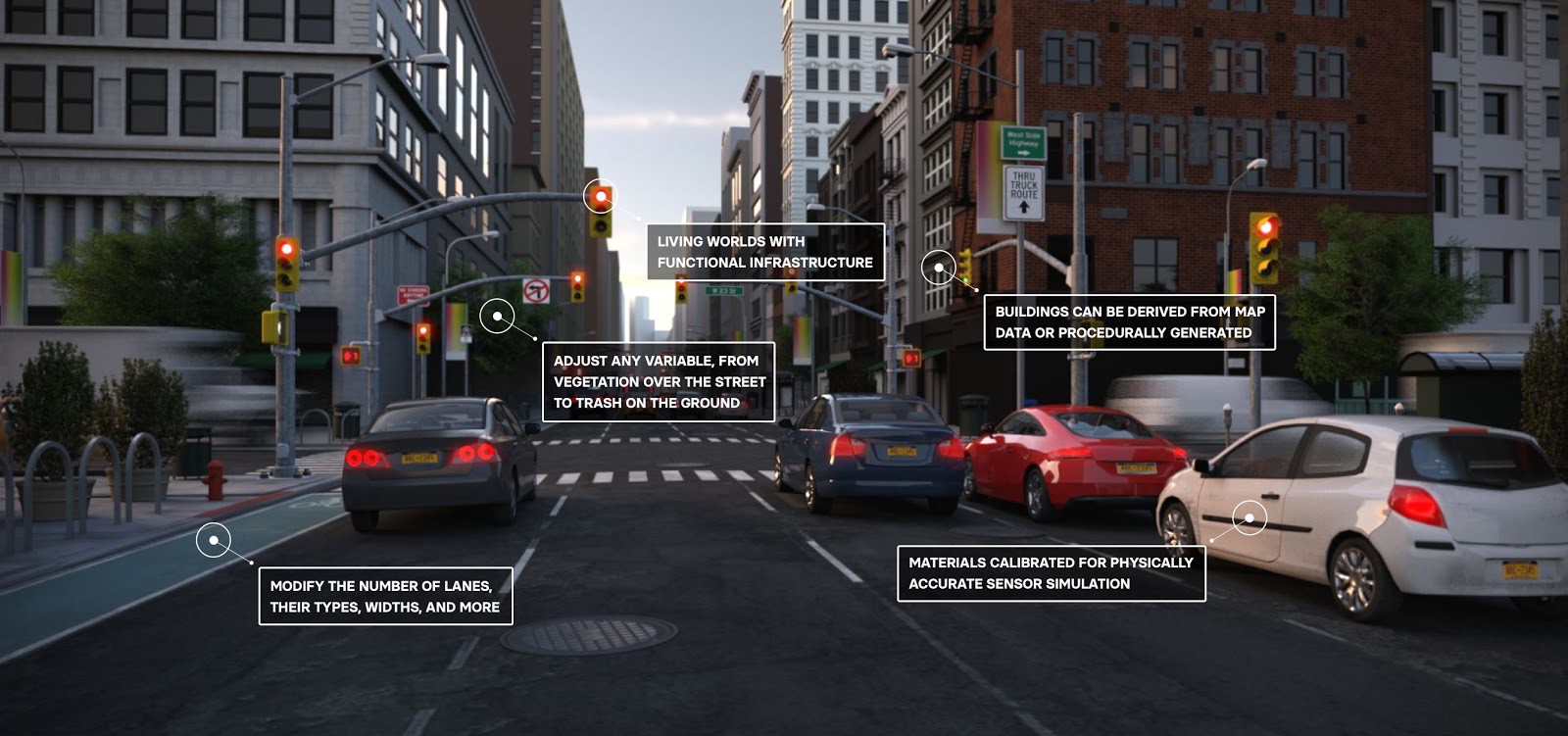
Parallel Domain
Founded 2017 · United States · paralleldomain.com
SnapshotCompany claim
Parallel Domain provides sensor simulation and reconstruction software for Physical AI. Founded in 2017, it creates production-grade simulation environments from real-world capture for autonomous vehicles, drones, and robots. Its product PD Replica turns real data into geometrically accurate, labeled digital twins for validation.
- Founded
- 2017
- HQ
- United States
- Models
- 2
- Categories
- 1
Product families
Is this your company? Claim this profile to add verified data, respond to our analysis, and upgrade claims to Verified.
Claim this profile1. Executive Overview {#executive-overview}
Parallel Domain is a United States-based software company, founded in 2017, that has built a focused position in sensor simulation and reconstruction for Physical AI. Its core value proposition is converting real-world fleet capture data into production-grade, simulation-ready digital twins — enabling autonomous vehicle, drone, eVTOL, delivery robot, and agricultural autonomy programs to validate perception and planning systems at the scale safety demands. The company describes its customer base as including "the largest autonomy programs in the world," a claim that, while unverified by third parties in the data available, is consistent with the technical maturity of its product offering and the enterprise and deep-tech investor backing it has secured.
The company's strategic pivot — from procedural world generation (its founding approach) to reconstructive simulation anchored in real captured data — reflects a deliberate philosophical bet aligned with what AI researcher Richard Sutton termed the "Bitter Lesson": that generalized systems trained on real data outperform hand-programmed logic over time. Parallel Domain frames this shift as both a product decision and a market timing call, noting that its customers are themselves moving from modular perception-planning-control stacks to end-to-end learned models that place much higher demands on simulation quality and fidelity. PD Replica is the product built for that transition.
Leadership was reinforced in March 2026 with the appointment of Zack Novak as CEO, explicitly tasked with scaling commercial and go-to-market execution. Founder Kevin McNamara, who brings computer graphics experience from Apple's Special Projects Group, Pixar, and Microsoft Game Studios, transitions to Chief Product Officer, retaining direct oversight of PD Replica and customer engagement. The company reports "a year of fast growth" across testing and validation following Replica's introduction, though specific revenue or customer count figures are not publicly disclosed.
Latest news
- KEENON Humanoid Pours Drinks at GCS 2026, 100,000 Others Run HotelsYanko Design·2026-06-15GENERAL
2. The Company Story {#the-company-story}
Parallel Domain was founded in 2017 by Kevin McNamara, who had previously led autonomous systems simulation work within Apple's Special Projects Group and held roles at both Pixar Animation Studios (contributing to Academy Award-winning productions) and Microsoft Game Studios (architecting procedural content systems). That background — spanning photorealistic rendering, procedural world-building, and autonomous systems — directly shaped the company's original approach: building procedural simulation environments at a scale and quality that the nascent autonomy industry had not previously seen.
For approximately six years, the company's core product was that procedural generation engine. Customers building autonomous vehicles and related systems used these synthetic environments to generate labeled training data and run simulation-based validation. In December 2020, Techcouver reported that Parallel Domain had raised $11 million to accelerate computer vision development, providing an early external data point on the company's fundraising trajectory. The company also launched Data Lab, a self-serve API for synthetic data generation, covered by BigDATAwire/HPCwire — indicating a period when Parallel Domain was positioning itself as a scalable data infrastructure provider for computer vision teams.
The more consequential strategic inflection came when McNamara and the team concluded that procedural generation — however sophisticated — was fundamentally limited by the human logic baked into it. The company made the decision to shift its entire approach toward reconstructive simulation: ingesting real fleet capture data and converting it into geometrically accurate, physically valid, semantically labeled, HD-mapped digital twins. The result is PD Replica, the company's current flagship product. This shift required building new core capabilities — the PD Pose Engine for handling GPS drift, sparse coverage, and sensor misalignment; a physics-aware collision layer; and automated sim-to-real validation pipelines.
In March 2026, Zack Novak joined as CEO, bringing go-to-market experience from industrial AI and enterprise software environments, including Uptake and Quantix. The company describes itself as "backed for the long term" by enterprise and deep-tech investors, though specific investor names and round sizes beyond the 2020 $11M raise are not publicly detailed in available data. Parallel Domain's positioning today is as infrastructure for the Physical AI era — a horizontal simulation platform whose addressable market has expanded well beyond passenger vehicles to any domain where sensor-equipped autonomous systems must be validated before real-world deployment.
3. Product Portfolio {#product-portfolio}
Products & versions


Parallel Domain's current product lineup consists of two complementary platforms — PD Replica and PD Sim — that together address the full arc from real-world data ingestion to large-scale deterministic scenario testing.
PD Replica is the company's reconstructive simulation product and its primary strategic differentiator. It accepts raw fleet capture data as input and produces what the company calls "Replicas, not reconstructions" — the distinction being that the output is simulation-ready, dynamic, and physically valid, rather than a static mesh or passive 3D model. Replica supports camera, lidar, and radar simulation with multi-sensor rig support; generates semantic and instance segmentation labels suitable for perception training; produces fully annotated HD maps with lane geometry, traffic rules, and routing; and includes a physics-aware collision layer for realistic dynamics. The PD Pose Engine specifically addresses the messiness of real-world capture data — handling GPS drift, sparse sensor coverage, and inter-sensor misalignment. A notable capability is the ability to insert entirely new agents into reconstructed scenes with calibrated lighting and scene metadata, enabling counterfactual scenario generation within a real-world-derived environment. The product carries a documented maximum corridor length of 3 km per Replica, a specification that defines the current unit of reconstruction granularity.
PD Sim is a deterministic, scalable multi-sensor simulation platform designed for CI/CD-integrated testing at very high volume — the company describes it as capable of scaling "from one scenario to one million." It supports camera, lidar, and radar with physically-based sensor outputs, offers a Python SDK for full programmatic control, and provides closed-loop integration with autonomy stacks. Its determinism is a deliberate engineering choice: reproducible failure cases are essential for systematic debugging and regression testing. PD Sim's CI/CD integration positions it as a developer-facing tool that fits into existing software engineering workflows rather than requiring a separate simulation operations team.
Together, the two products form a pipeline: Replica reconstructs the real world into validated, high-fidelity simulation environments, and Sim scales testing across those environments and beyond. This two-product architecture serves both the data quality problem (Replica) and the coverage and throughput problem (Sim) — the two dominant challenges in autonomous system validation.
4. Technology Stack {#technology-stack}
Parallel Domain's technical foundation is most clearly legible through the capabilities documented in its product specifications and the professional backgrounds of its leadership team.
The reconstruction pipeline at the core of PD Replica requires solving several hard computer vision and geometry problems simultaneously: multi-sensor fusion across camera, lidar, and radar modalities; pose estimation and correction under real-world GPS degradation and sensor misalignment (addressed by the PD Pose Engine); surface reconstruction sufficient to support a physics-aware collision layer; and semantic labeling automated enough to produce production-scale annotated outputs. Our read: the PD Pose Engine is likely a graph-optimization or factor-graph-based pipeline for sensor pose refinement, consistent with established practices in SLAM and Structure-from-Motion, though Parallel Domain has not published technical details of its implementation. The 3 km maximum corridor length per Replica is a concrete operational parameter that implies chunked or tiled reconstruction architecture rather than unbounded scene reconstruction.
The rendering engine — led by VP of Engineering Brian Townsend, whose background includes computer vision engineering at Amazon — must produce physically-based sensor outputs for all three modalities (camera, lidar, radar). Our read: physically-based lidar and radar simulation at production fidelity is significantly more computationally intensive than camera rendering alone; the fact that Parallel Domain explicitly claims all three suggests a non-trivial investment in sensor physics modeling, likely including material reflectance properties relevant to radar cross-section and lidar return intensity. Kevin McNamara's background at Pixar and Microsoft Game Studios (procedural content, rendering pipelines) is directly relevant to the rendering engine's maturity.
The Python SDK in PD Sim, combined with CI/CD integration, indicates a software-first, API-driven platform design rather than a GUI-centric simulation tool — consistent with serving engineering organizations running automated testing pipelines. The ability to scale to one million scenarios implies a cloud-native or distributed compute architecture, though Parallel Domain has not disclosed its infrastructure provider or deployment model.
Limited public technical detail is available on the specific neural architectures, if any, used in the reconstruction pipeline, on sim-to-real gap quantification methodology, or on the rendering engine's underlying technology (e.g., rasterization vs. ray tracing vs. neural rendering). These would be meaningful disclosures for technical due diligence. Not yet disclosed — Parallel Domain is invited to provide additional technical documentation.
5. Research, Papers, Authors, Labs {#research-papers}
Company-linked papers
Parallel Domain does not present itself as a research-publishing organization, and no academic papers, preprints, or named research lab affiliations appear in the available data. This is consistent with its positioning as a production software and infrastructure company rather than a research institution — the same is true of most commercial simulation and tooling vendors in the autonomous systems space. The intellectual contribution of the company is expressed through its products and engineering, not through the academic literature.
Not yet disclosed: if Parallel Domain has published technical reports, dataset papers (e.g., accompanying any publicly released synthetic datasets), or workshop contributions at venues such as CVPR, ICCV, or ITSC, the company is invited to surface those here.
6. Media Evidence {#media-evidence}
Media library
Third-party press coverage in the available data includes three external sources: a BigDATAwire/HPCwire report covering the launch of Data Lab, Parallel Domain's self-serve API for synthetic data generation; a Techcouver report from December 2020 documenting an $11 million fundraising round to accelerate computer vision development; and a LeadIQ company overview entry. The HPCwire and Techcouver pieces represent substantive independent editorial coverage from outlets focused on data infrastructure and technology investment, respectively, and provide external validation of the company's product activity and early funding history.
7. Commercial Reality {#commercial-reality}
Customers & deployments
Parallel Domain's About page states that "the largest autonomy programs in the world rely on Parallel Domain" for data engineering and simulation validation — this is a company claim and has not been independently verified in the data available. No specific customer names, contract values, fleet sizes, deployment volumes, or revenue figures are publicly disclosed.
Revenue: Not disclosed. Parallel Domain is invited to share verifiable commercial metrics.
Customer count: Not disclosed. The company's own language references a broad customer base across automotive, drone, eVTOL, last-mile delivery, and agricultural autonomy, but no enumeration is available.
ROI / cost metrics: PD Sim's product description references scaling to millions of test miles "at a fraction of the cost of real-world driving" — this is a company claim; no third-party cost comparison data is available to validate the specific magnitude.
The $11 million raise documented in 2020 (Techcouver) is the only disclosed funding figure. The company describes its current investor base as "enterprise and deep-tech investors" focused on long-term infrastructure — investor names and subsequent round details are not publicly available in the data provided. Parallel Domain is invited to disclose updated funding and commercial milestones.
8. Markets and Use Cases {#markets-use-cases}
Parallel Domain's About page and product descriptions collectively map out a well-defined set of target markets, all unified by a common underlying problem: the need to validate sensor-based autonomous systems against simulated real-world conditions before deployment.
Autonomous passenger vehicles and trucks represent the company's founding market and remain its deepest reference point. The need to accumulate the equivalent of "a billion miles" in simulation before a system is safe enough for public roads is the explicit framing Parallel Domain uses to justify its platform — and the 3 km Replica corridor specification reflects the kind of road-segment-level reconstruction relevant to vehicle testing programs.
Drones and eVTOL aircraft are explicitly named as growth markets. The sensor simulation challenge for these platforms differs from ground vehicles in meaningful ways — flight dynamics, altitude-dependent lidar returns, and the relative scarcity of aerial capture datasets — but the core pipeline (capture in, validated simulation out) is identical. Parallel Domain's claim that "the aperture has widened" to these domains suggests active customer engagement rather than purely prospective positioning.
Last-mile delivery robots represent a third named vertical. Ground-based delivery robots operating in pedestrian environments require dense semantic understanding of dynamic scenes — exactly the capability that Replica's semantic and instance segmentation outputs and agent-insertion functionality address.
Agricultural autonomy is the fourth named domain. Agricultural environments — fields, orchards, farm roads — present distinct sensor challenges (unstructured terrain, variable lighting, GPS-degraded environments) where the PD Pose Engine's handling of sparse coverage and GPS drift would be directly applicable.
Across all four domains, the common use case pattern is: ingest existing fleet or drone capture data → reconstruct validated simulation environments → run large-scale scenario tests in PD Sim → validate perception and planning models against real-world-derived ground truth before physical deployment. The CI/CD integration in PD Sim further extends the use case into continuous engineering workflows, where every model update triggers automated regression testing.
9. Competitive Landscape {#competitive-landscape}
Competitive comparison
| Robot | Maker | Autonomy | Conf. |
|---|---|---|---|
| iRobot Roomba Combo 10 Max | iRobot | Autonomous | 0.90 |
| Mobile ALOHA (Stanford) | Stanford University | Teleoperated | 0.90 |
| 1X NEO | 1X Technologies | Remote-Assisted | 0.90 |
Parallel Domain operates in the sensor simulation and synthetic data infrastructure category — a segment that has attracted investment from both dedicated simulation software vendors and in-house tooling efforts at large autonomy programs. The category is defined by the shared need to generate labeled, physically valid sensor data at a scale and cost that real-world collection cannot match, and to validate the fidelity of that simulation against real-world ground truth.
Parallel Domain's specific combination of reconstructive simulation (real capture → digital twin) with deterministic multi-sensor scenario testing, CI/CD integration, and multi-domain applicability (ground vehicles, drones, robots) positions it at the infrastructure layer of the Physical AI stack. The competitive dynamics in this space turn primarily on reconstruction fidelity, sensor physics accuracy, pipeline automation, and the ability to handle the messy real-world capture data that production fleets actually generate — dimensions on which Parallel Domain's product specifications make explicit claims. The module above provides category context; Parallel Domain's differentiation rests on the reconstructive approach and the PD Pose Engine's handling of real-world data imperfections, which are specific and auditable technical claims.
10. Country Advantage / Geopolitical {#geopolitical}
Section not material for this company.
11. Hype vs Real vs Ugly {#hype-real-ugly}
Claim tracker
Real (verifiable or specifically grounded):
- Parallel Domain was founded in 2017 — documented.
- An $11 million funding round was reported by Techcouver in December 2020 — independently covered.
- Data Lab, a self-serve API for synthetic data generation, was covered by BigDATAwire/HPCwire — independently reported product milestone.
- PD Replica and PD Sim are documented products with specific, enumerated feature sets — company-claim, auditable against the product.
- Kevin McNamara's background at Apple's Special Projects Group (autonomous systems simulation), Pixar, and Microsoft Game Studios is stated on the company's own site — company-claim, consistent with publicly verifiable career history.
- The 3 km maximum corridor length for PD Replica is a disclosed product specification — company-claim, specific and testable.
Company claims (stated, not independently verified in available data):
- "The largest autonomy programs in the world rely on Parallel Domain." — company-claim; no named customers or third-party confirmation in available data.
- "A year of fast growth across testing and validation." — company-claim; no revenue or volume metrics disclosed to validate the characterization.
- PD Sim scales to one million scenarios "at a fraction of the cost of real-world driving." — company-claim on cost efficiency; no third-party benchmark available.
- The platform produces "production-grade" simulation environments — company-claim on quality tier; no independent fidelity benchmark cited.
Gaps (not hype, but genuinely undisclosed):
- No named customers, deployment case studies, or independently verified ROI data are publicly available. Not yet disclosed — the company is invited to provide verifiable references.
- No subsequent funding rounds beyond the 2020 $11M raise are documented in available data. Not yet disclosed.
- No technical publications or independent benchmarks of sim-to-real fidelity are available to assess reconstruction quality claims against external standards.
Our read: The product architecture — reconstructive simulation plus deterministic CI/CD-integrated scenario testing across camera, lidar, and radar — is technically coherent and addresses real, well-documented problems in autonomous system development. The philosophical framing around the Bitter Lesson is intellectually honest about the company's own strategic pivot. The gap between strong product claims and absent public customer evidence is the primary credibility question for external evaluators.
12. Future Scenarios {#future-scenarios}
Bull case — Our read: Physical AI validation becomes a mandatory infrastructure layer across automotive, drone, and robotics programs as regulatory scrutiny increases and end-to-end learned models demand higher-fidelity simulation. Parallel Domain's reconstructive approach proves to be the right architecture for that world, Replica adoption scales across its four named verticals, and the CI/CD integration in PD Sim embeds the platform deeply into engineering workflows at major autonomy programs. The March 2026 CEO appointment accelerates enterprise go-to-market execution at a moment when the market is expanding faster than internal tooling efforts at customer organizations can keep up.
Base case — Our read: Parallel Domain establishes durable positions in two or three of its named verticals — most likely automotive and one adjacent domain — while the broader Physical AI market develops more slowly than bullish forecasts suggest. Revenue grows steadily, the company remains a specialized but respected infrastructure vendor, and it competes effectively on technical differentiation (reconstruction fidelity, Pose Engine robustness) rather than platform breadth. Funding continues at a pace consistent with sustained growth, and the company either reaches profitability as a focused vendor or is acquired by a larger autonomy stack provider.
Bear case — Our read: Large autonomy programs increasingly invest in proprietary simulation infrastructure, constraining the addressable market for independent vendors. The 3 km corridor length limitation and the dependency on high-quality fleet capture data prove to be friction points for customers with limited or heterogeneous capture fleets. New entrants leveraging generative AI for world synthesis — an approach Parallel Domain explicitly moved away from — produce competitive-quality environments at lower cost. The gap between product capability claims and publicly verifiable commercial traction widens, making enterprise sales cycles longer and investor patience thinner.
13. What to Watch {#what-to-watch}
- Named customer disclosures: Any public reference customers across automotive, drone, eVTOL, delivery, or agricultural verticals would materially validate the company's commercial scale claims.
- Funding announcements: No round beyond the 2020 $11M raise is publicly documented; a new financing event would signal both commercial momentum and investor confidence in the reconstructive simulation thesis.
- Replica corridor length evolution: The current 3 km specification is a concrete product constraint; expansion of this parameter would indicate pipeline maturation and readiness for larger-scale highway or long-haul trucking programs.
- Sim-to-real validation benchmarks: Any independently published or third-party-verified fidelity metrics would convert the "production-grade" claim from company assertion to auditable fact.
- New vertical announcements: Watch for formal product positioning or case studies in eVTOL or agricultural autonomy, which the company names as growth markets but does not yet support with public deployment evidence.
- Technical publications: Any dataset papers, workshop contributions, or technical reports would increase visibility into reconstruction methodology and support third-party evaluation.
- CEO Zack Novak's go-to-market execution: His mandate is explicitly commercial scaling; partnership announcements, enterprise contract disclosures, or significant headcount growth in sales would be early indicators of progress.
- Competitive response to generative world synthesis: Monitor whether generative AI-based simulation approaches (which Parallel Domain consciously moved away from) produce fidelity gains that challenge the reconstructive approach's differentiation.
14. Sources & Methodology {#sources-methodology}
Data sources used in this report:
-
Parallel Domain company website (paralleldomain.com) — About page, product pages for PD Replica and PD Sim, leadership bios. All content from this source is treated as company-claim and labeled accordingly. It reflects the company's own characterization of its history, products, capabilities, and customers, and has not been independently audited.
-
Third-party press coverage (independent sources):
- HPCwire / BigDATAwire — coverage of Data Lab self-serve API launch (outlet named; treated as independent editorial validation of a product milestone).
- Techcouver (December 9, 2020) — coverage of $11 million funding round (outlet named; treated as independent validation of a financing event).
- LeadIQ — company overview entry (directory/data aggregator; treated as corroborating but lower-authority).
Methodology and rubric (applied consistently to every company on this platform):
- Every factual claim is grounded only in the data above. No products, customers, revenue figures, partnerships, or technical specifications have been invented or inferred beyond what the source data supports.
- Claims originating from the company's own site are labeled "company-claim" and are not presented as independently verified facts.
- Inferences drawn from product specifications or market context are labeled "Our read:" to distinguish analyst interpretation from sourced fact.
- Gaps — information that would be material but is absent from available data — are rendered as "Not yet disclosed" with an invitation to the company to provide or correct information.
- No unsourced negative claims are made as statements of fact.
- This report reflects data available at time of generation; live modules (news, products, customers, competitors, papers, media, claims) draw from continuously updated sources and may reflect more current information than the prose sections.
PD Replica by Parallel Domain is a simulation-ready, dynamic world reconstruction service. It turns fleet capture data into high-fidelity replicas with physics-aware worlds, multi-sensor simulation (camera, lidar, radar), semantic segmentation, and HD maps. The PD Pose Engine handles messy real-world data (GPS drift, sparse coverage, misalignment). Automated sim-to-real validation provides quantitative quality reports. Replicas cover corridors up to 3 km long, enabling closed-loop testing of full driving scenarios.
- •Replicas, not reconstructions – simulation-ready dynamic world
- •Static and dynamic reconstruction of environment and actors
- •Physics-aware world with collision layer for realistic dynamics
- •Camera, lidar, and radar simulation with multi-sensor rig support
- •Insert entirely new agents with calibrated lighting and scene metadata
- •Semantic and instance segmentation labels for perception training
- •Fully annotated HD map with lane geometry, traffic rules, routing
- •PD Pose Engine handles GPS drift, sparse coverage, sensor misalignment
- •Automated sim-to-real validation with geometric, appearance, annotation fidelity
- •Corridors up to 3 km long for full scenario testing
| Max corridor length km | 3 |
Technology stackOur read
Inferred from product specs — click through to the technology wiki:
ResearchComputed
Product comparisonComputed
Company announcement
News and Media
The company's official social & video channels · external links
News
From third-party news outlets (China & abroad) · external links