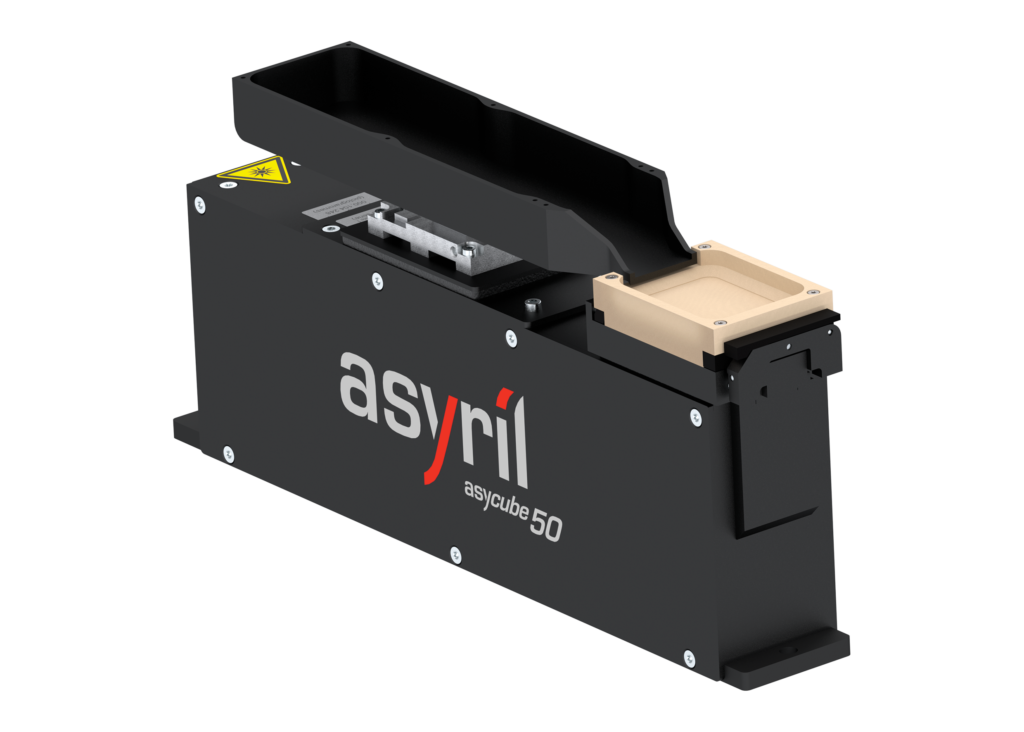
Asyril
Switzerland · asyril.com
SnapshotCompany claim
Asyril is based in Switzerland with subsidiaries in Germany, the USA, Japan, and Singapore. It relies on a worldwide network of distributors. Headquarters, R&D, and production are in Villaz-St-Pierre, Switzerland.
- Founded
- Not disclosed
- HQ
- Switzerland
- Models
- 2
- Categories
- 2
ContactCompany claim
- Address
- Z.I. du Vivier 22, 1690 Villaz-St-Pierre, Switzerland
Product families
Is this your company? Claim this profile to add verified data, respond to our analysis, and upgrade claims to Verified.
Claim this profile1. Executive Overview {#executive-overview}
Asyril is a Swiss precision-automation company specialising in flexible parts-feeding systems for industrial robotics. Headquartered in Villaz-St-Pierre, Switzerland — where it co-locates its R&D and manufacturing — the company has built a genuinely global commercial footprint, with wholly owned subsidiaries in Germany, the United States, Japan, and Singapore, supplemented by a worldwide distributor network. This combination of Swiss engineering provenance and multi-continent presence positions Asyril as a specialist supplier to manufacturers who require reliable, high-throughput component feeding across diverse part geometries.
The company's product identity is anchored in its Asycube platform of flexible feeders, which has attracted coverage from industry outlets including automate.org, Robotics and Automation Magazine, and distributor-facing channels such as onexia.com. The Merlin concept — a recently introduced large-part feeding system handling components up to 300 mm — extends the portfolio upward in part size and signals continued product investment. Asyril's founding date is not publicly disclosed on its website; all further claims in this report are grounded in data extracted from the company's own site or named third-party sources.
Latest news
- KEENON Humanoid Pours Drinks at GCS 2026, 100,000 Others Run HotelsYanko Design·2026-06-15GENERAL
2. The Company Story {#the-company-story}
Asyril's founding date is not disclosed in available public data. What the company's own materials establish clearly is its Swiss identity: headquarters, R&D, and production are all sited at Z.I. du Vivier 22, 1690 Villaz-St-Pierre, Switzerland, reflecting a model in which core intellectual property and manufacturing remain onshore in Switzerland while commercial reach is extended through subsidiaries and distributors.
The company's geographic expansion tells a story of deliberate internationalisation. Subsidiaries in Offenburg, Germany; Edina, Minnesota, USA; Yokohama, Japan; and Singapore's Ang Mo Kio technology district collectively cover the four major advanced-manufacturing regions — Europe, North America, East Asia, and Southeast Asia. The Japanese address, situated within the German Industry Park in Yokohama, is a notable detail suggesting alignment with precision-engineering and automotive-adjacent customer bases in that market.
Asyril's positioning, as reflected in its own site navigation and product naming conventions, is that of a complete flexible feeding solution provider: it offers not only hardware (the Asycube feeder family and the Merlin concept) but also vision software (EYE+ and EYE+ XTD), a smart hopper (Asyfill), and supporting plugins — framing the company as a system integrator's one-stop source rather than a component vendor. Third-party coverage on automate.org specifically calling out the Asycube 380 as newsworthy, and Robotics and Automation Magazine covering the company at a 2022 trade event, corroborates the company's claim to a recognised market presence in the flexible-feeding category.
3. Product Portfolio {#product-portfolio}
Products & versions


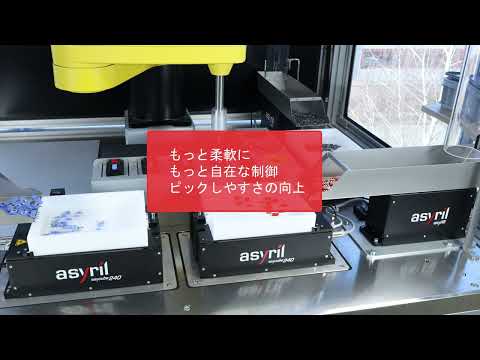
Asyril's portfolio, as presented on its own site, organises into four functional layers. The first is the Asycube flexible feeder family — the core product line — which the company describes as capable of handling a wide range of part sizes and geometries through vibration-based feeding. The Asycube 380, specifically, was notable enough to merit a dedicated news item on automate.org, suggesting it represents a significant platform extension. A specialised variant, the Asycube Clean, addresses controlled-environment applications, implying coverage of medical-device or semiconductor assembly contexts where particulate contamination is a concern.
The second layer is vision and intelligence: the EYE+ system and its extended variant EYE+ XTD are presented as dedicated vision controllers for the Asycube, and the PYK+ (marked as new) appears to be a further plugin in this intelligence stack. The third layer is the Asyfill smart hopper, which handles bulk-part supply upstream of the feeder. The fourth and most recently introduced element is the Merlin concept, a flexible feeding system for large parts up to 300 mm (12 in), featuring CAD-based part teaching via a web interface, integrated lighting, AI-based lighting immunity, surround cameras capable of detecting pickable parts during robot movement, and a vibrating-and-rising floor mechanism designed to maintain constant cycle time through the final parts in the bin — addressing a well-known pain point in bin-picking applications. Merlin is currently at pilot customer program stage, which the company discloses directly. Together the portfolio spans small-part high-speed feeding through to large, heavy, or vibration-sensitive component handling.
4. Technology Stack {#technology-stack}
The most technically detailed product in Asyril's disclosed portfolio is the Merlin concept, and it rewards close reading. The system's specified handling range — 100 mm to 300 mm (4 in to 12 in) part size — places it in a segment that conventional vibratory bowl feeders and smaller flexible feeders cannot address, and the design choices reflect the engineering challenges of that size class.
Our read: The combination of "integrated lighting" and "AI-teaching" for lighting immunity suggests that Asyril has moved beyond simple 2D blob detection toward a learning-based vision pipeline that is trained on CAD geometry rather than physical part samples. CAD-to-teach workflows are increasingly standard in advanced bin-picking systems and reduce changeover time significantly; Asyril's claim of an "intuitive web interface" for this process implies the vision stack is browser-accessible, which would be consistent with modern containerised or embedded-compute architectures.
Our read: "Surround cameras detect pickable parts even during robot movement" implies a multi-camera array with either continuous frame capture and motion compensation, or a sensor-fusion approach that does not depend on a static scene — a non-trivial engineering choice that reduces cycle-time dead-bands. The "vibrating and rising floor" mechanism is a mechanical solution to the last-part problem in large-part feeding, where gravity and part geometry conspire to leave unpickable clusters; this is a kinematic rather than purely software solution, suggesting Asyril retains strong mechanical-design capability alongside its vision software work.
The broader EYE+ platform, described as a dedicated vision controller for the Asycube, implies a purpose-built compute unit rather than a generic PC-based vision system — consistent with the company's integration-focused positioning. Limited public technical detail is available on the EYE+ XTD variant's specific extensions, the PYK+ plugin's function, or the underlying processor and communication protocols used across the range. Not yet disclosed: full technical specifications for EYE+, EYE+ XTD, and PYK+ — Asyril is invited to share or correct this data.
5. Research, Papers, Authors, Labs {#research-papers}
Company-linked papers
Asyril does not appear to be an academic research publisher. This is entirely normal for a product-focused precision-automation company: its innovation is embodied in commercial hardware and software rather than in peer-reviewed literature. No papers, named research authors, or affiliated academic labs are referenced in the company's own materials or in the third-party sources available for this report. If Asyril has research collaborations or publications not reflected on its public site, the company is invited to submit those details for inclusion.
6. Media Evidence {#media-evidence}
Media library
Three named third-party outlets have covered Asyril in available data: automate.org (the Automation Federation's news channel) reported on the launch of the Asycube 380 flexible feeding system; Robotics and Automation Magazine (roboticsandautomationmagazine.co.uk) covered Asyril's exhibition presence at the Robotics and Automation 2022 trade event, with that article indexed as recently as November 2025; and onexia.com, a robotics distributor and integrator, published a 2023 piece titled "High Performance Flexible Feeders for Robotics" referencing Asyril's systems. Collectively these represent trade-press and channel-partner validation across the UK, US, and integrator communities, consistent with a specialist B2B supplier rather than a consumer-facing brand.
7. Commercial Reality {#commercial-reality}
Customers & deployments
Revenue, customer counts, contract values, and ROI figures for Asyril are not disclosed in any available public source. This is standard practice for a privately held Swiss industrial company of this profile. The existence of four international subsidiaries and a worldwide distributor network is structural evidence of commercial activity at meaningful scale, but no specific numbers can be responsibly cited here.
The Merlin concept is described by Asyril as being in a "pilot customer program," which is a company-claim indicating early-stage commercial deployment rather than full market release. Named customers, deployment sites, throughput benchmarks, or cost-per-pick figures: not yet disclosed. Asyril is invited to submit verified customer references, deployment data, or independently audited performance figures for inclusion in a future revision of this report.
8. Markets and Use Cases {#markets-use-cases}
Asyril's product design choices and third-party coverage together allow reasonable inference about the markets it serves, even where the company's own product records do not carry explicit industry tags.
The Asycube Clean variant directly implies cleanroom-compatible applications: medical device assembly, pharmaceutical packaging, and semiconductor or microelectronics manufacturing are the natural addressable segments for a feeder designed to operate in controlled-contamination environments. The core Asycube platform — a high-speed flexible feeder for small parts — maps to the classical use cases that flexible feeding was developed to address: consumer electronics assembly, connector and fastener feeding, watch and precision-instrument manufacturing (highly relevant given Switzerland's industrial heritage), and automotive sub-assembly.
The Merlin concept opens a distinct and larger addressable market. At 100–300 mm part sizes, with explicit callouts for "heavy" and "vibration-sensitive" parts, the system is suited to feeding larger mechanical components: castings, housings, structural brackets, and similar items found in automotive, heavy equipment, white goods, and industrial machinery assembly lines. The "constant cycle time through the very last part" feature specifically addresses high-OEE (Overall Equipment Effectiveness) production environments where feeder starvation is a documented line-efficiency problem.
The company's geographic presence — Germany, USA, Japan, Singapore — maps closely to the world's highest-concentration advanced-manufacturing clusters, reinforcing that Asyril's target customers are tier-1 and tier-2 manufacturers and the system integrators who serve them.
9. Competitive Landscape {#competitive-landscape}
Competitive comparison
| Robot | Maker | Autonomy | Conf. |
|---|---|---|---|
| iRobot Roomba Combo 10 Max | iRobot | Autonomous | 0.90 |
| Mobile ALOHA (Stanford) | Stanford University | Teleoperated | 0.90 |
| 1X NEO | 1X Technologies | Remote-Assisted | 0.90 |
The flexible parts-feeding market sits at the intersection of industrial automation, machine vision, and robotic integration. It is populated by a mix of specialist flexible-feeder manufacturers, broader robotics platform companies offering integrated feeding accessories, and custom automation builders. Asyril's differentiation, as expressed in its own materials, rests on the combination of Swiss-origin precision hardware, a proprietary vision-and-intelligence layer (EYE+), and a portfolio that now spans from small-part high-speed feeding to large-part bin-picking with the Merlin concept.
The module above contextualises Asyril within its same-category peer set. What the product data supports analytically is that Asyril competes less on price and more on flexibility, ease of changeover (CAD-based teaching), and the ability to handle a wider part-size envelope than single-point solutions. The Asycube Clean variant also positions the company in a higher-specification, higher-margin segment that not all general-purpose flexible feeder suppliers address.
10. Country Advantage / Geopolitical {#geopolitical}
Switzerland's position as a non-EU, politically neutral precision-engineering hub is modestly relevant to Asyril. Swiss-made industrial equipment carries recognised provenance in high-specification manufacturing procurement, particularly in medical devices and precision instruments — segments that align with the Asycube Clean and the core Asycube platform. Switzerland's bilateral agreements with the EU facilitate trade with Asyril's German subsidiary and broader European customer base without full EU regulatory exposure.
Our read: For a company selling capital equipment to manufacturers in the US, Japan, Singapore, and Germany, Swiss neutrality and CPTPP/bilateral trade structures reduce geopolitical supply-chain risk compared to manufacturers headquartered in jurisdictions subject to export controls or trade-bloc tensions. This is a background structural advantage rather than a headline competitive differentiator, but it is materially real for procurement officers evaluating long-term supplier stability. No specific geopolitical risk or country-advantage claim is made by Asyril in its own materials; the above is analytical inference, labeled accordingly.
11. Hype vs Real vs Ugly {#hype-real-ugly}
Claim tracker
What the data supports as verified or independently corroborated:
- Asyril operates subsidiaries in four countries (Germany, USA, Japan, Singapore) — confirmed by the company's own site with named addresses and phone numbers.
- The Asycube 380 is a real product that received independent trade-press coverage on automate.org.
- Asyril exhibited at Robotics and Automation 2022, per Robotics and Automation Magazine.
- The Merlin concept handles parts up to 300 mm — a company-claim with specific, verifiable specifications.
Company claims that are plausible but not independently verified in available data:
- "AI-teaching" for lighting immunity in the Merlin concept — company-claim; the underlying methodology and validation data are not publicly available.
- "Constant cycle time through the very last part" — company-claim; no independent benchmark data is cited in available sources.
- CAD-based part teaching via "intuitive web interface" — company-claim; no third-party usability evaluation is available.
- "Surround cameras detect pickable parts even during robot movement" — company-claim; no independent cycle-time or detection-accuracy data is available.
Gaps that are fixable:
- The Merlin concept is at pilot customer program stage; full commercial performance data does not yet exist publicly. Not yet disclosed: pilot results, customer names, throughput figures. Asyril is invited to submit this data.
- TWS 2024 appears in the product data with no specifications, description, or use-case information. Not yet disclosed: what TWS 2024 is. Asyril is invited to clarify or correct.
- No founding date is publicly available. Not yet disclosed: year of establishment and founding story. Asyril is invited to claim this.
12. Future Scenarios {#future-scenarios}
Our read — Bull case: The Merlin concept successfully exits its pilot customer program and enters full commercial release, establishing Asyril in the large-part flexible feeding segment with limited direct specialist competition. EYE+ XTD and PYK+ plugins expand the software revenue stream and increase customer switching costs. The four-subsidiary global structure accelerates adoption across automotive and electronics manufacturing clusters in Germany, the US Upper Midwest, Japan, and Southeast Asia simultaneously. Switzerland's precision-engineering reputation continues to command price premium in medical and semiconductor feeding applications.
Our read — Base case: Merlin transitions to commercial availability over a 12–24 month horizon with a modest initial customer base drawn from existing Asycube integrators. The core Asycube platform maintains its position as a respected mid-market flexible feeder. Growth tracks the broader collaborative and flexible automation market — solid but not breakout. The distributor network continues to carry most volume outside the five subsidiary markets.
Our read — Bear case: The large-part bin-picking segment proves more difficult to serve at scale than the pilot program suggests, either due to the mechanical complexity of the rising-floor mechanism, integration demands on the customer side, or competition from larger robotics platform companies bundling feeding solutions. If pilot customer data does not validate the "constant cycle time" and "very last part" claims under real production conditions, Merlin's commercial ramp slows. The company's privately held structure limits its ability to invest aggressively in parallel product lines simultaneously.
13. What to Watch {#what-to-watch}
- Merlin commercial release: Transition from pilot customer program to general availability is the single most significant near-term signal. Watch for a formal launch announcement, pricing disclosure, and first named reference customers.
- TWS 2024 clarification: This product entry carries no specifications or description. Any public disclosure of its nature and market positioning will materially change the portfolio picture.
- EYE+ XTD and PYK+ detail: Specifications and use cases for these newer platform additions have not been publicly detailed. Release of documentation or case studies will clarify the company's software-and-intelligence strategy.
- Pilot customer results: Any independently reported throughput, OEE, or changeover-time data from Merlin pilot sites would validate or qualify the company's performance claims.
- Trade show presence: Asyril's 2022 appearance at Robotics and Automation is on record. Future event appearances — particularly at Automatica, Automate, or Japan's IREX — would signal commercial momentum and provide opportunities for independent product evaluation.
- Distribution network expansion: Any additions to the named subsidiary or distributor network, particularly in South Korea, India, or Mexico, would indicate geographic growth strategy.
- Founding story and company history: If Asyril publishes a formal company timeline, milestone dates would allow better contextualisation of its growth trajectory.
14. Sources & Methodology {#sources-methodology}
Primary source: All factual claims about Asyril's products, locations, personnel, and positioning are drawn from content extracted from asyril.com (the company's own website). This content is treated throughout this report as company-claim provenance — accurate representations of what Asyril says about itself, not independently audited facts.
Third-party sources cited by name:
- automate.org — Automation Federation trade news; cited for Asycube 380 product coverage.
- roboticsandautomationmagazine.co.uk — UK trade publication; cited for 2022 exhibition coverage (article indexed November 2025).
- onexia.com — Robotics integrator/distributor; cited for 2023 flexible feeder feature referencing Asyril.
Computed relations: Competitive context, market categorisation, and peer groupings are generated analytically from product category and use-case tags; these are labeled "Our read" throughout and are not company claims.
What this report does not do: It does not invent customers, revenue figures, specifications, partnerships, or research outputs not present in the source data. Where information is absent, the report says so explicitly and invites the company to submit corrections or additions.
Universal rubric: This methodology applies uniformly to all company intelligence reports in this series. Every company is evaluated against the same evidentiary standard: verified facts sourced and labeled, inferences labeled as inferences, gaps identified as fixable rather than damning, and no unsourced negatives stated as fact.
The Merlin concept is a flexible feeding system for large parts up to 300 mm. It uses an intuitive web interface for CAD-based part teaching, integrated lighting and AI for lighting immunity, and surround cameras for detection during robot movement. A vibrating and rising floor ensures constant cycle time and picks every last part, even heavy or vibration-sensitive ones.
- •Handles parts up to 300 mm (12 in)
- •Teach parts from CAD files with an intuitive web interface
- •Immune to different lighting conditions thanks to integrated lighting and AI-teaching
- •Surround cameras detect pickable parts even during robot movement
- •Constant cycle time through the very last part in the bin
- •Compatible with heavy and vibration-sensitive parts
- •Vibrating and rising floor ensures every last part is picked
| Part size max in | 12 |
| Part size max (mm) | 300 |
| Part size min in | 4 |
| Part size min (mm) | 100 |
Technology stackOur read
Inferred from product specs — click through to the technology wiki:
ResearchComputed
Product comparisonComputed
Company announcement
News and Media
The company's official social & video channels · external links



News
From third-party news outlets (China & abroad) · external links