antobot
SnapshotCompany claim
Company description not yet disclosed.
- Founded
- Not disclosed
- HQ
- Not disclosed
- Models
- 1
- Categories
- 1
ContactCompany claim
- Not disclosed
- Address
- Arise Innovation Hub, Alan Cherry Drive, Chelmsford, CM1 1QT, United Kingdom
Product families
Is this your company? Claim this profile to add verified data, respond to our analysis, and upgrade claims to Verified.
Claim this profile1. Executive Overview {#executive-overview}
Antobot.ai has brought to market a commercially specified autonomous UV-C treatment robot — the U303 — designed for protected horticulture environments. The product is notable for its practical engineering: a 48 V / 80 Ah battery system, adjustable height to accommodate varying tabletop dimensions (80–150 cm), and a reported economic outcome of 20–30% yield increase for strawberry growers. The company positions itself in the precision-agriculture robotics segment, targeting fungal disease management as an autonomous, overnight or off-hours workflow — a genuine operational problem in soft-fruit cultivation worldwide.
Beyond the U303, public information about Antobot.ai's founding date, headquarters country, leadership team, and commercial scale is not yet disclosed on the company's public-facing site. The contact page is the primary public interface, suggesting the company may be in an early commercial or pre-scale phase, or may share detailed information selectively with partners and customers. This report is therefore anchored to the verified product specification and feature set available from their domain.
Latest news
- KEENON Humanoid Pours Drinks at GCS 2026, 100,000 Others Run HotelsYanko Design·2026-06-15GENERAL
2. The Company Story {#the-company-story}
What is verifiable: Antobot.ai operates under the domain antobot.ai and has at minimum one commercial-grade outdoor agricultural robot — the U303 — in its portfolio. The product's specificity (tubeless tyres rated 13 × 4.30–8, approach/departure angles of 25°, adjustable mast height 1,300–1,800 mm) indicates a product that has progressed well beyond concept stage into engineering validation and likely field deployment.
What is inferred (Our read): The naming convention "U303" — with a category prefix and three-digit number — suggests Antobot may be developing or planning a broader product line rather than a single-product company. The focus on horticulture and UV-C treatment points to a founding thesis centred on chemical-reduction or pesticide-alternative agri-tech, a segment attracting regulatory tailwinds in Europe and Australasia in particular.
Gaps: Founding year, founding team, country of incorporation, and any disclosed investment or grant history are not yet publicly stated. Not yet disclosed — Antobot.ai is invited to claim or correct this information.
3. Product Portfolio {#product-portfolio}
Products & versions


Antobot.ai's publicly documented lineup currently consists of a single product family: the U303 [OUTDOOR], an autonomous UV-C treatment robot purpose-built for tabletop horticulture — most explicitly, strawberry cultivation under protected structures.
The U303's physical envelope (1,350 mm long × 633 mm wide, height adjustable 1,300–1,800 mm) is sized to navigate the row corridors typical of raised-bed strawberry and soft-fruit production systems. At 170 kg, the platform carries meaningful ballast for stability during UV-C lamp operation, and the 80 Ah / 48 V battery (54.5 V charge cut-off) delivers a 2.5-hour runtime per cycle — consistent with a single-pass treatment of a commercial glasshouse or polytunnel block during overnight hours when workers are absent, which is the standard safety protocol for UV-C deployment around humans. The 25° approach and departure angles indicate the chassis is engineered for the shallow ramps and lip transitions common in greenhouse floor infrastructure.
The fleet-management capability — one operator managing multiple units — is the primary labour-efficiency argument. At present, no second product model, accessory module, or software platform is publicly documented. Not yet disclosed: additional product lines or software stack details — the company is invited to provide further information.
4. Technology Stack {#technology-stack}
Based on the published specification, the following technology elements are either confirmed or inferable:
UV-C Treatment System: The core payload is a UV-C irradiation system targeting fungal pathogens (botrytis and powdery mildew are the primary targets in strawberry horticulture). The product description confirms autonomous, agile, and accurate UV-C delivery, implying some form of positional control or sensing to maintain consistent lamp-to-canopy distance — particularly relevant given the adjustable height range of 500 mm.
Navigation and Autonomy: The robot is described as autonomous, operating outdoors in structured agricultural row environments. Our read: row-following in tabletop horticulture is a well-defined autonomy problem, typically addressed with a combination of LiDAR, wheel odometry, and/or camera-based row detection. The outdoor classification and the tyre specification (tubeless pneumatic) suggest the platform is designed for the semi-structured, occasionally uneven surfaces of polytunnel floors rather than indoor flat concrete — a meaningfully harder navigation environment than warehouse robotics.
Fleet Management: The one-operator-to-fleet ratio implies either a centralised scheduling and monitoring interface (web or mobile) or a low-intervention autonomous return-to-base capability. Our read: given the 2.5-hour runtime, a fleet deployment likely involves staggered start times, automatic docking, or operator-managed battery swaps.
Power Architecture: The 48 V nominal / 54.5 V cut-off battery specification is consistent with lithium iron phosphate (LiFePO₄) chemistry, which is standard for outdoor agricultural platforms due to thermal stability. Our read: this is an inference from the voltage profile — not explicitly stated by the company.
Limited public technical detail is available regarding the sensor suite, software stack, connectivity protocols, or AI/ML components. Not yet disclosed — the company is invited to provide technical documentation.
5. Research, Papers, Authors, Labs {#research-papers}
Company-linked papers
Antobot.ai does not appear to be a research-publishing organisation based on available public data. This is common and unremarkable for a commercial service-robotics and agri-tech hardware company at this stage. The 20–30% yield increase figure cited in the product description is a company claim; the underlying study methodology, sample size, and conditions are not yet publicly cited. Not yet disclosed — Antobot.ai is invited to link or reference the underlying data supporting this yield figure.
6. Media Evidence {#media-evidence}
Media library
No third-party media coverage, press releases, trade publication features, or analyst citations are linked on the company's public site. Not yet disclosed — if coverage exists in agri-tech, horticulture, or robotics trade outlets, Antobot.ai is invited to surface it here.
7. Commercial Reality {#commercial-reality}
Customers & deployments
Revenue, customer count, named deployments, and return-on-investment case studies are not disclosed in any publicly available company material. The 20–30% yield increase for strawberry farmers is presented as a product benefit (company claim) but is not attributed to a named customer, trial site, or published study.
Not yet disclosed: commercial traction data, customer references, deployment geography, and pricing. Antobot.ai is invited to claim or disclose this information to strengthen third-party confidence in the platform.
Our read: The existence of a fully specified, physically detailed commercial product with real engineering tolerances — tyre size, charge cut-off voltage, approach angle — suggests the company has moved beyond paper concept into at least prototype or pilot production. Whether this reflects active commercial sales or an ongoing pilot phase is not determinable from public data alone.
8. Markets and Use Cases {#markets-use-cases}
The U303's documented use case is precise: autonomous UV-C fungal disease management in tabletop horticulture, with strawberry farming explicitly called out as the primary application. This positions Antobot.ai at the intersection of two active investment themes — precision agriculture and chemical-input reduction.
Primary market — protected strawberry cultivation: Botrytis (grey mould) and powdery mildew are the dominant fungal threats to strawberry crops in polytunnel and glasshouse systems. UV-C treatment as a fungicide alternative has been validated in academic literature over the past decade, and growers face increasing pressure to reduce chemical applications due to regulation (particularly in the EU and UK) and retailer sustainability requirements. An autonomous overnight UV-C robot addresses both the efficacy and labour-cost dimensions of this problem.
Adjacent horticulture markets: The tabletop adaptation range of 80–150 cm and the outdoor chassis suggest potential applicability to other tabletop-grown soft fruits (raspberries, blueberries) and potentially to other row-crop protected horticulture settings. Our read: these are natural adjacencies, but no such markets are explicitly claimed by the company at this time.
Fleet economics: The one-operator-to-fleet model targets medium-to-large commercial growing operations where labour cost is a material line item and overnight deployment is operationally viable.
9. Competitive Landscape {#competitive-landscape}
Competitive comparison
| Robot | Maker | Autonomy | Conf. |
|---|---|---|---|
| iRobot Roomba Combo 10 Max | iRobot | Autonomous | 0.90 |
| Mobile ALOHA (Stanford) | Stanford University | Teleoperated | 0.90 |
| 1X NEO | 1X Technologies | Remote-Assisted | 0.90 |
The autonomous UV-C agricultural robot segment is a focused niche within the broader agri-robotics market. Antobot.ai competes in a category defined by the combination of UV-C payload delivery, row-crop navigation in protected horticulture, and autonomous fleet operation — a more specific competitive set than general field robotics or greenhouse automation broadly defined.
Our read: The barriers to entry in this segment are meaningful — UV-C dosimetry, safe autonomous operation in environments that may occasionally include workers during daytime, and the physical robustness required for outdoor polytunnel use all require genuine engineering effort. However, the segment has attracted attention from both dedicated agri-robotics startups and established horticultural equipment manufacturers exploring automation. The module above reflects computed peer relationships; prose naming of specific competitors is withheld in keeping with this report's methodology.
10. Country Advantage / Geopolitical {#geopolitical}
Section not material for this company.
The country of incorporation and primary operating market for Antobot.ai are not yet publicly disclosed, making geopolitical framing speculative. Not yet disclosed — the company is invited to clarify its operational geography.
11. Hype vs Real vs Ugly {#hype-real-ugly}
Claim tracker
Real (verified from public specification):
- The U303 exists as a physically specified product with engineering-grade dimensions, weight, battery spec, tyre size, and operational angles — these are not conceptual claims.
- The tabletop height adaptation range (80–150 cm) and the outdoor classification reflect design decisions grounded in real horticulture infrastructure.
- Fleet operation under a single operator is a documented feature claim.
Company claims (stated but not independently verified):
- "20–30% yield increase reported" for strawberry farmers. This is a meaningful economic claim — company-stated, source not cited. Antobot.ai is invited to link the supporting data or trial documentation.
- "Autonomous, agile, accurate UV-C treatment" — the autonomy and accuracy claims are consistent with the product category but are not independently verified by any linked field trial or third-party assessment.
Gaps, not negatives:
- No customer references, no deployment scale, no pricing, no regulatory compliance documentation (e.g., UV-C safety standards adherence) are publicly available. These are fixable disclosure gaps, not evidence of absence. Not yet disclosed — the company is invited to provide supporting documentation.
12. Future Scenarios {#future-scenarios}
Bull case — Our read: Antobot.ai captures early-mover positioning in autonomous UV-C horticulture robotics across major soft-fruit producing regions (UK, Netherlands, Spain, South Korea, Australia) as chemical fungicide regulation tightens. The fleet model scales efficiently; the yield improvement claim, if substantiated with published data, becomes a compelling sales tool. A second product platform targeting adjacent crops or additional horticultural inputs (e.g., biostimulants, imaging) broadens the addressable market.
Base case — Our read: The company establishes a defensible niche in strawberry and soft-fruit UV-C treatment, grows a regional customer base, and iterates on the U303 platform based on field data. Progress is steady but constrained by the relatively small addressable market of commercial tabletop strawberry growers willing to adopt autonomous robotics. Fleet sizes remain modest per deployment.
Bear case — Our read: Without disclosed customer traction, funding, or a named commercial partner, there is a scenario in which the company remains pre-commercial or struggles to achieve the fleet density required for unit economics to work at scale. Larger agricultural machinery companies entering the UV-C robotics segment with established distribution networks would compress the window for independent positioning.
13. What to Watch {#what-to-watch}
- Yield claim substantiation: Publication or citation of the methodology behind the 20–30% strawberry yield increase figure would materially validate the commercial proposition.
- Country/region disclosure: Identification of the primary operating market would clarify regulatory environment, target customer base, and competitive exposure.
- Second product announcement: Any new model designation beyond U303 would signal the company's product roadmap ambitions and R&D depth.
- Named customer or deployment reference: A first public case study or named grower partner would be a significant commercial signal.
- Fleet size benchmarks: Disclosure of how many units are in field operation (even in aggregate) would indicate production and commercial scale.
- Regulatory and safety documentation: UV-C systems in agricultural settings carry worker safety requirements; public disclosure of compliance standards met would reduce adoption friction for commercial buyers.
- Investment or grant announcements: Any disclosed funding round, government agri-tech grant, or strategic partnership would indicate trajectory and backing.
14. Sources & Methodology {#sources-methodology}
Primary source: All factual claims in this report are derived exclusively from content extracted from antobot.ai — the company's own public-facing website, including product pages and the contact page. All such content carries company-claim provenance and has not been independently verified.
Computed relations: Competitive peer groupings, market adjacency inferences, and module-linked data (news, competitors, customers, papers, media) are generated from structured data relationships computed by the platform, not from additional primary research.
Inference labelling: All analytical interpretations not directly supported by the source data are labelled "Our read:" throughout. These represent analyst inference, not reported fact.
Uniform rubric: This methodology applies identically to every company report produced by this platform. No company receives a different evidential standard. Gaps are noted as fixable disclosure opportunities, not as negative assessments.
Invitation to correct: Antobot.ai or any authorised representative is invited to submit corrections, additional documentation, or updated disclosures. Claims submitted by the company will be labelled accordingly and distinguished from independently verified information.
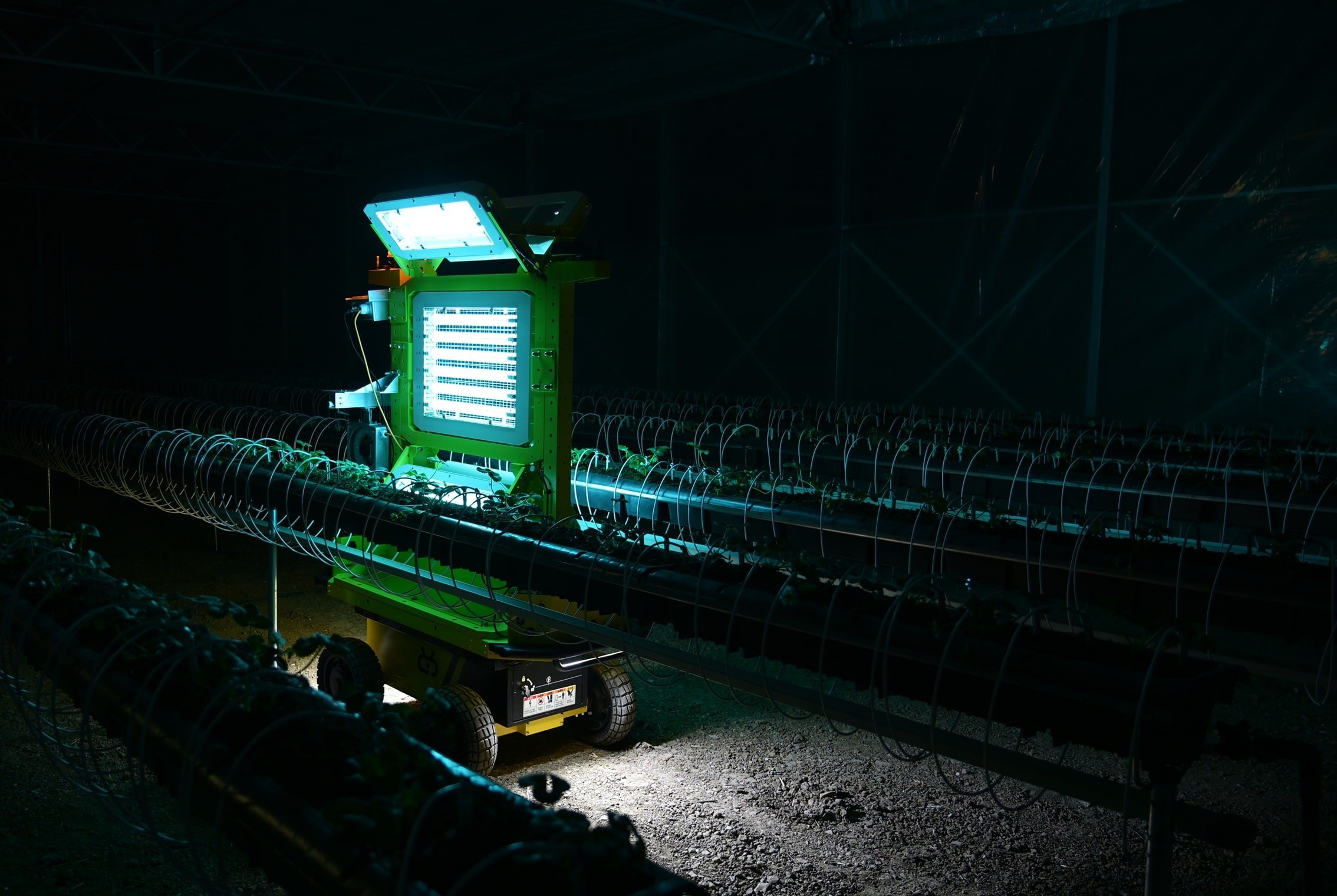
U303 is an autonomous, agile, accurate UV-C treatment robot targeting fungal diseases on crops in horticulture. It adapts to tabletops of 80-150 cm, offers economic benefits for strawberry farmers (20%-30% yield increase reported), and allows one operator to manage a fleet. Dimensions: (1300-1800)x633x1350 mm, weight 170 kg, battery 48V-80Ah, runtime 2.5 h.
- •Adaptive to various dimensions of tabletop (80-150 cm)
- •Economic benefits for strawberry farmers (20%-30% yield increase reported)
- •One operator can manage a fleet
- •Autonomous, agile, accurate UV-C treatment
- •Targets fungal diseases on crops in horticulture
| Width | 633 mm |
| Height | 1300-1800 mm |
| Length | 1350 mm |
| Tyre size | 13 x 4.30 - 8 (tubeless) |
| Weight | 170 kg |
| Runtime | 2.5 h |
| Battery voltage (v) | 48 |
| Approach angle (deg) | 25 |
| Battery capacity ah | 80 |
| Departure angle (deg) | 25 |
| Charge cutoff voltage (v) | 54.5 |
Technology stackOur read
Inferred from product specs — click through to the technology wiki:
ResearchComputed
Product comparisonComputed
Each row leads with this company's product, side-by-side with similar ones · click a row to expand full specs, click again to collapse
U303

ANYmal D Max
Lunar Rover R1
RB-VOGUI
Dobot M1

FarmBot | Open-Source CNC Farming